Multi-Cloud Strategy: Benefits, Challenges and Best Practices for Modern Businesses
Cloud computing has become a critical part of modern business infrastructure. As organizations adopt digital transformation, AI, data analytics, enterprise applications, and remote operations, many businesses are moving beyond a single-cloud environment.
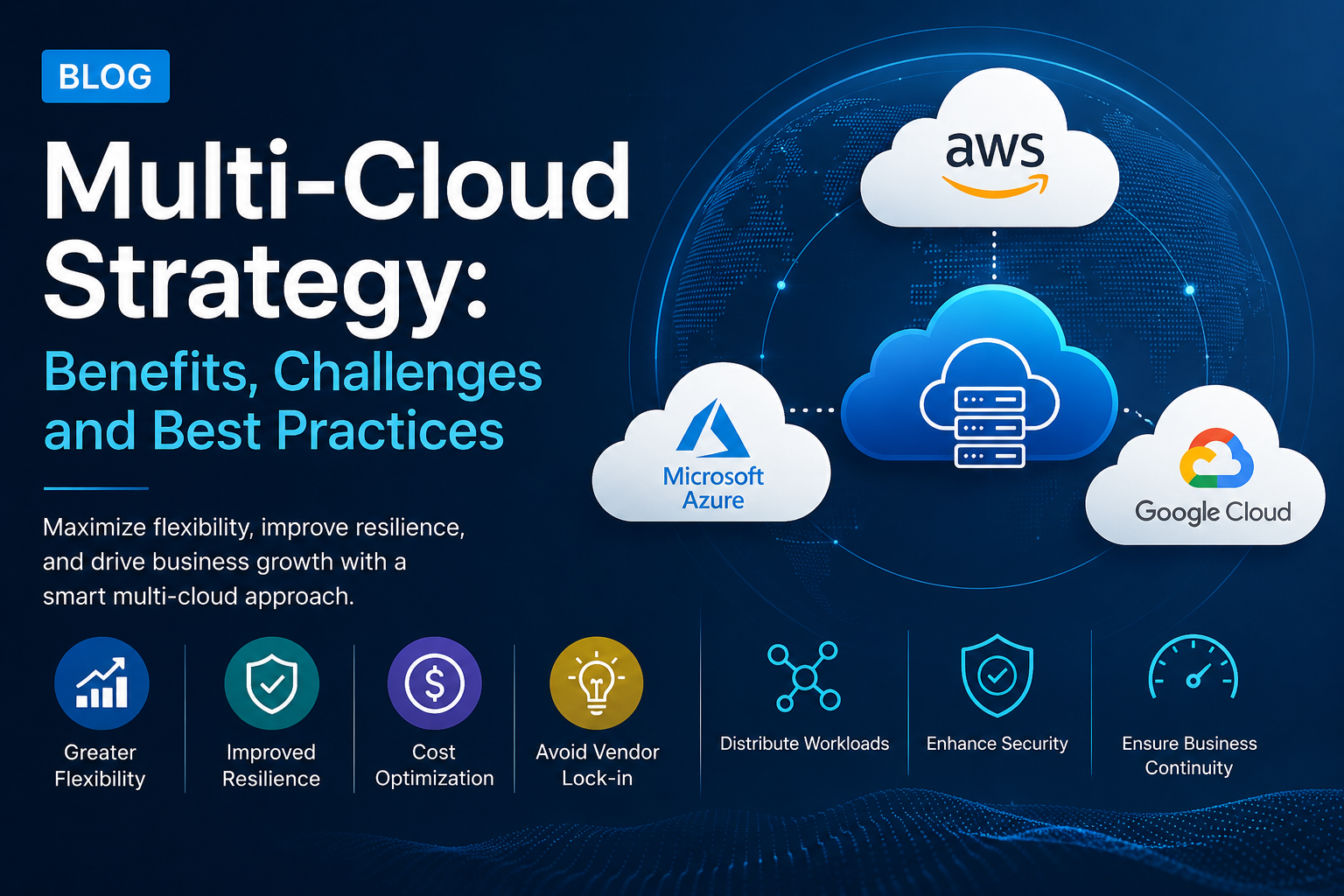
A multi-cloud strategy allows organizations to use services from multiple cloud providers based on their specific business, performance, security, and scalability requirements. Instead of depending entirely on one provider, businesses can strategically distribute workloads across different cloud platforms.
For growing organizations, multi-cloud can provide greater flexibility and access to advanced technologies. However, managing multiple cloud environments also introduces challenges related to security, governance, integration, cost, and operational complexity.
This article explores the major benefits, challenges, and best practices businesses should consider when developing a multi-cloud strategy.
What Is a Multi-Cloud Strategy?
A multi-cloud strategy is an approach where an organization uses two or more cloud service providers for its applications, infrastructure, storage, databases, analytics, or other workloads.
For example, a business might use different cloud platforms for:
- Enterprise applications
- Data analytics
- AI and machine learning
- Backup and disaster recovery
- Customer-facing applications
- Development and testing
- Data storage
The objective is not simply to use multiple providers. Instead, organizations should select the right cloud environment for each workload while maintaining consistent security, governance, and operational control.
Benefits of a Multi-Cloud Strategy
1. Greater Flexibility
Multi-cloud allows businesses to select cloud services based on specific technical and business requirements. Organizations can choose platforms that provide the right combination of performance, scalability, pricing, and capabilities.
This flexibility can be particularly valuable for businesses with diverse workloads.
2. Reduced Vendor Dependency
Depending entirely on one cloud provider can create long-term vendor dependency. A multi-cloud approach can provide organizations with additional flexibility when technologies, pricing, or business requirements change.
However, businesses should not adopt multi-cloud solely to avoid vendor lock-in. The additional operational complexity should provide a clear business advantage.
3. Access to Advanced Technologies
Different cloud providers offer specialized services across AI, analytics, databases, security, and application development.
With a multi-cloud strategy, businesses can select specialized technologies that best match their requirements rather than limiting their technology choices to one ecosystem.
4. Improved Business Continuity
A properly designed multi-cloud environment can support business continuity and disaster-recovery strategies.
By distributing suitable workloads across different environments, organizations can reduce their dependence on a single infrastructure provider.
However, simply using multiple clouds does not guarantee resilience. Applications, data, networking, identity, and recovery processes must be properly designed and tested.
5. Geographic and Compliance Flexibility
Businesses operating across multiple countries or regions may have specific requirements related to data residency, regulatory compliance, and application latency.
Multi-cloud architecture can provide additional deployment options for meeting regional and regulatory requirements.
Challenges of Multi-Cloud Adoption
1. Increased Complexity
Managing multiple cloud environments can be significantly more complex than managing a single platform.
IT teams may need to work with different:
- Management consoles
- APIs
- Networking architectures
- Security models
- Monitoring tools
- Identity systems
- Pricing structures
Without proper governance, this complexity can affect productivity and operational efficiency.
2. Security Management
Maintaining consistent security across multiple cloud environments is a major challenge.
Businesses need unified approaches to:
- Identity and access management
- Authentication
- Encryption
- Vulnerability management
- Security monitoring
- Logging
- Compliance
- Incident response
A fragmented security strategy can create visibility gaps and increase risk.
3. Cost Management
Multi-cloud environments can create unexpected expenses through:
- Data transfer
- Cloud storage
- Unused resources
- Duplicate services
- Licensing
- Network infrastructure
- Management overhead
Organizations should establish centralized cloud-cost monitoring and regularly review resource utilization.
4. Integration Issues
Applications and databases operating across different cloud platforms may face compatibility, networking, API, synchronization, and latency challenges.
Businesses should carefully evaluate dependencies before distributing connected workloads across multiple providers.
5. Skills and Expertise
Multi-cloud management requires teams with knowledge across cloud architecture, networking, DevOps, cybersecurity, automation, monitoring, and infrastructure management.
Organizations may need to invest in employee training or work with experienced technology partners to successfully manage multi-cloud environments.
Best Practices for Implementing a Multi-Cloud Strategy
1. Define Clear Business Objectives
Before adopting multiple cloud providers, businesses should identify the specific reasons for doing so.
Common objectives include:
- Improving application performance
- Supporting business continuity
- Meeting compliance requirements
- Accessing specialized technologies
- Expanding into new regions
- Optimizing infrastructure costs
- Supporting digital transformation
A clear objective helps prevent unnecessary infrastructure complexity.
2. Analyze Workloads
Not every application needs to operate across multiple clouds.
Businesses should evaluate workloads based on:
- Performance
- Security
- Compliance
- Data sensitivity
- Cost
- Availability
- Latency
- Scalability
- Business importance
Workloads should then be assigned to the cloud environment that best meets their requirements.
3. Establish Strong Governance
Effective governance is essential for controlling a multi-cloud environment.
Organizations should establish clear standards for:
- Security
- Access management
- Data protection
- Compliance
- Resource management
- Cloud costs
- Infrastructure deployment
- Monitoring
Centralized governance can provide consistency while allowing individual teams to work efficiently.
4. Standardize Infrastructure
Technologies such as Infrastructure as Code, containers, APIs, CI/CD pipelines, and automation can help create consistency across cloud environments.
Standardization can reduce manual work and make infrastructure easier to manage.
However, businesses should avoid forcing every workload into identical architectures when cloud-specific services provide meaningful advantages.
5. Implement Centralized Security
Security should be considered from the beginning of the multi-cloud journey.
Businesses should implement:
- Multi-factor authentication
- Least-privilege access
- Encryption
- Centralized identity management
- Continuous monitoring
- Security logging
- Vulnerability management
- Regular security assessments
A unified security framework can provide better visibility across different cloud environments.
6. Strengthen Monitoring and Observability
Multi-cloud infrastructure requires comprehensive monitoring.
Organizations should monitor:
- Application performance
- Infrastructure health
- Network activity
- Security events
- Resource utilization
- Cloud spending
Centralized observability can help IT teams identify performance problems and security incidents more quickly.
7. Create a Strong Data Strategy
Data management is one of the most important aspects of multi-cloud architecture.
Before moving data between providers, organizations should consider:
- Data residency
- Replication
- Backup
- Recovery
- Synchronization
- Latency
- Data-transfer costs
- Security requirements
Poor data architecture can increase costs and reduce application performance.
8. Continuously Optimize Cloud Costs
Cloud optimization should be an ongoing process.
Businesses should regularly:
- Remove unused resources
- Review resource utilization
- Optimize workloads
- Monitor data-transfer costs
- Evaluate pricing models
- Establish departmental cost accountability
Effective FinOps practices can help organizations maintain better control over multi-cloud spending.
Multi-Cloud vs. Single-Cloud Strategy
Multi-cloud is not automatically better than a single-cloud strategy.
A single-cloud approach may be suitable for businesses with simpler infrastructure requirements, limited cloud expertise, or workloads that benefit from deep integration with one provider.
A multi-cloud approach can be more suitable for organizations that require specialized cloud services, geographic flexibility, greater infrastructure diversity, or specific resilience and compliance capabilities.
The right approach depends on the organization's business objectives, applications, data, budget, security requirements, and technical capabilities.
How Businesses Can Build a Multi-Cloud Roadmap
Organizations planning multi-cloud adoption can follow a structured approach:
- Define business objectives.
- Assess the current IT infrastructure.
- Identify and classify workloads.
- Evaluate suitable cloud providers.
- Design the security and identity framework.
- Establish governance policies.
- Develop networking and integration architecture.
- Implement centralized monitoring.
- Establish cloud-cost management.
- Test backup and disaster-recovery processes.
- Gradually migrate suitable workloads.
- Continuously optimize the environment.
A phased implementation can help businesses minimize operational disruption while building multi-cloud capabilities progressively.
The Role of Multi-Cloud in Digital Transformation
Multi-cloud is becoming increasingly relevant as organizations adopt AI, automation, analytics, enterprise software, and cloud-native applications.
Modern businesses need infrastructure that can support changing workloads without compromising security, performance, or scalability.
However, successful multi-cloud adoption is not about using as many cloud platforms as possible. It is about creating a strategic, secure, scalable, and well-governed technology environment that supports business growth.
How Clopid Can Help
At Clopid Smart Technology Solution, we help businesses leverage modern technology to build smarter, more scalable, and efficient digital operations.
From enterprise technology solutions to cloud-enabled applications, automation, AI, blockchain, CRM, ERP, and technical support, the right technology strategy can help businesses improve operational efficiency and prepare for future growth.
Explore Clopid to learn more about technology solutions designed for modern businesses.
Conclusion
A multi-cloud strategy can provide businesses with greater flexibility, access to specialized technologies, improved resilience, and greater control over their technology environment.
At the same time, organizations must carefully manage challenges related to security, governance, integration, cost, and operational complexity.
The most successful multi-cloud strategies begin with clear business objectives and are supported by strong governance, centralized security, effective monitoring, workload planning, and continuous cost optimization.
For businesses planning their next stage of digital transformation, multi-cloud can be a powerful strategy when implemented with the right architecture and long-term technology roadmap.
Frequently Asked Questions
What is a multi-cloud strategy?
A multi-cloud strategy involves using services from two or more cloud providers to support different business applications, workloads, or technology requirements.
What are the main benefits of multi-cloud?
Key benefits include flexibility, access to specialized technologies, reduced dependency on one provider, geographic flexibility, and potential improvements in business continuity.
What are the biggest challenges of multi-cloud?
The major challenges include security management, infrastructure complexity, cloud-cost control, integration, governance, and the need for specialized technical skills.
Is multi-cloud suitable for small businesses?
It can be, but businesses should evaluate whether the benefits justify the additional complexity and management costs. A well-managed single-cloud environment may be more appropriate for some smaller organizations.
How can businesses secure multi-cloud environments?
Businesses should use centralized identity management, least-privilege access, encryption, monitoring, security logging, vulnerability management, and consistent security policies across cloud platforms.