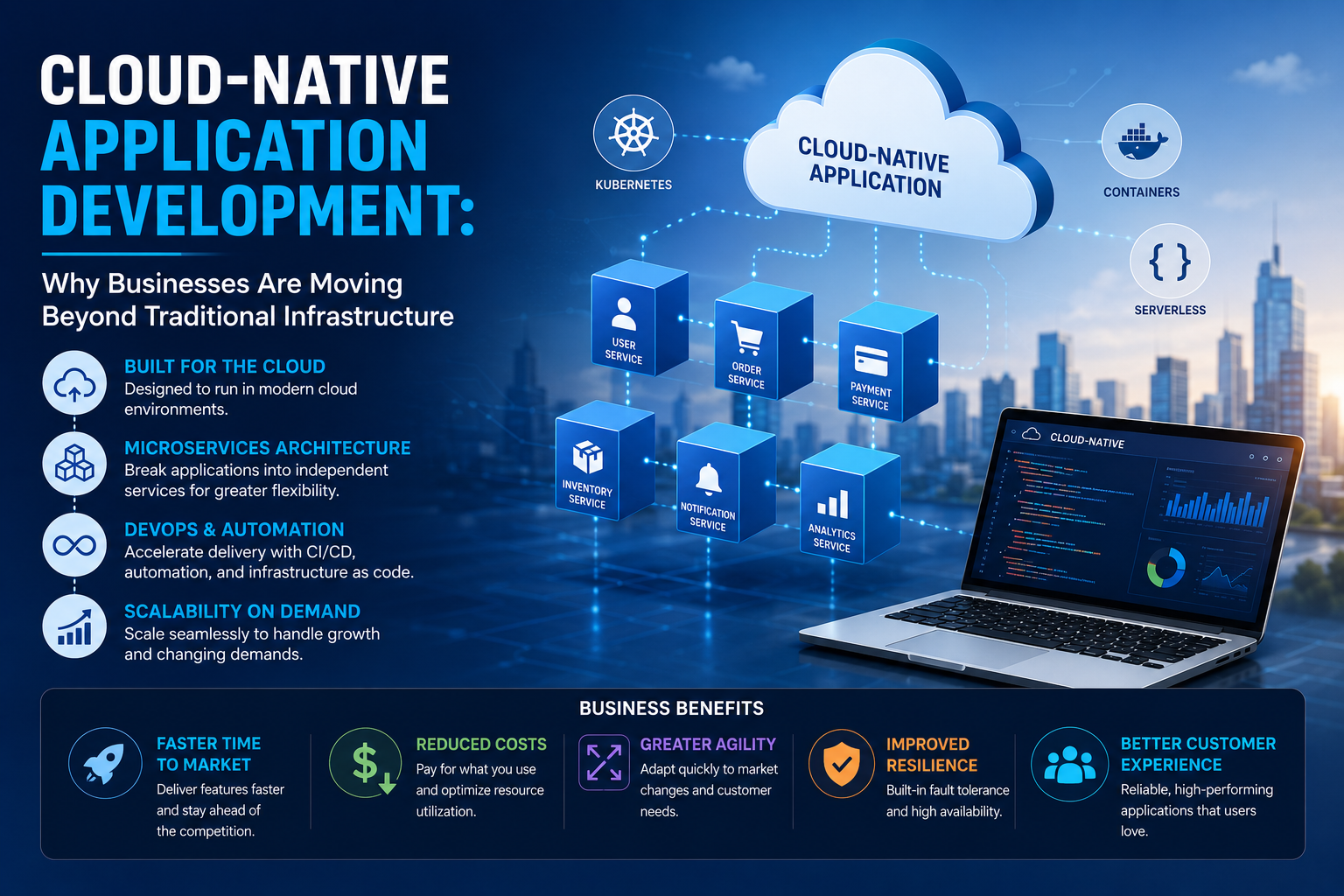
Cloud-Native Application Development: Why Businesses Are Moving Beyond Traditional Infrastructure
Businesses are under increasing pressure to deliver digital products faster, scale applications efficiently, and respond quickly to changing customer expectations. Traditional infrastructure and application development models can make these goals difficult to achieve, particularly as organizations expand their digital operations.
This is why many businesses are moving toward cloud-native application development.
Cloud-native development is more than simply hosting an existing application in the cloud. It involves designing applications and infrastructure around cloud capabilities such as containers, microservices, automation, orchestration, APIs, and continuous delivery.
For organizations seeking greater flexibility and scalability, cloud-native architecture can provide a foundation for building modern applications that can adapt to changing business requirements.
What Is Cloud-Native Application Development?
Cloud-native application development is an approach to building and operating software specifically for dynamic cloud environments.
Cloud-native applications commonly make use of technologies and practices such as:
- Microservices
- Containers
- Kubernetes and container orchestration
- APIs
- Infrastructure automation
- Continuous integration and continuous delivery
- Automated testing
- Observability
- DevOps practices
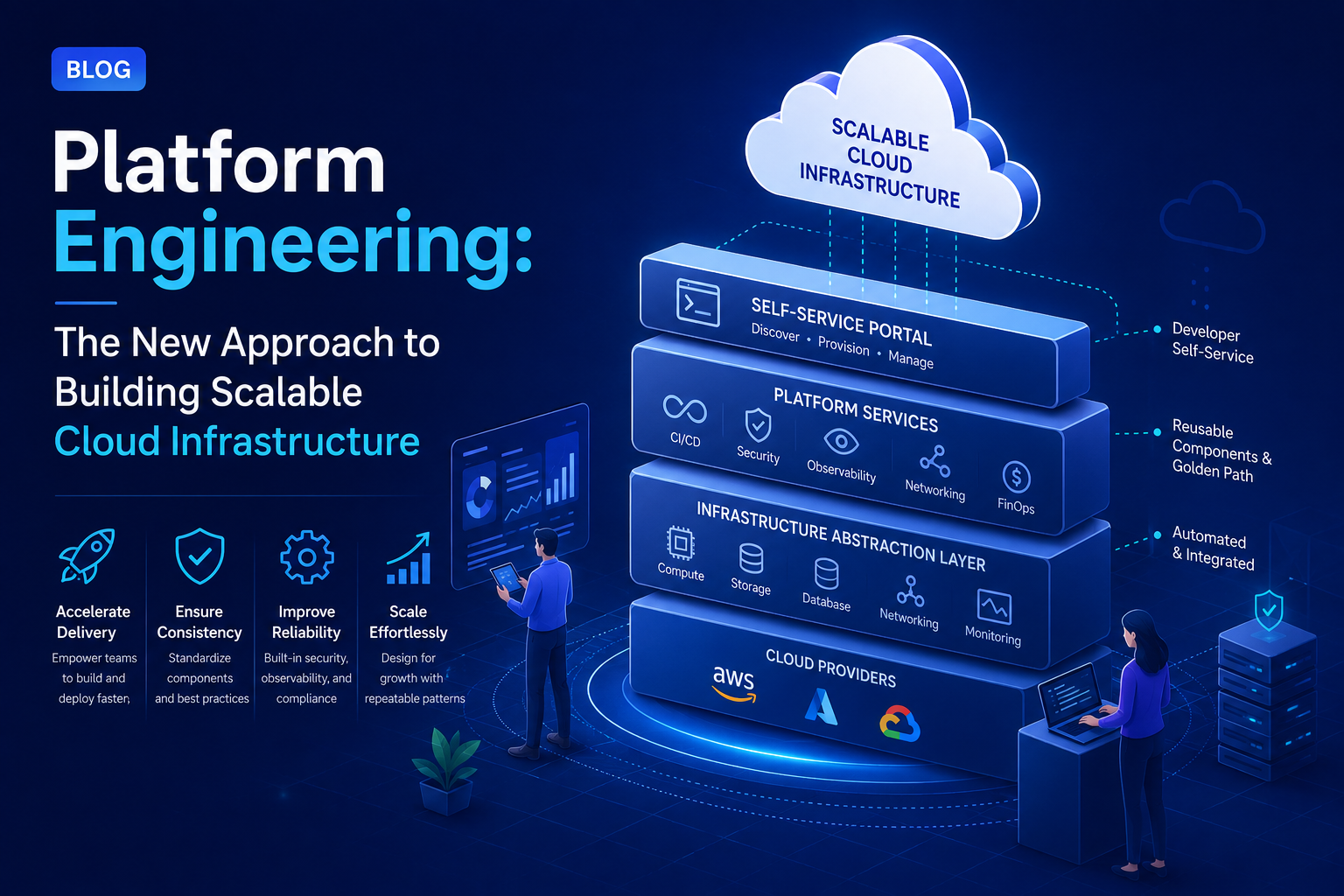
Instead of treating infrastructure as a fixed environment, cloud-native development encourages organizations to use automation and flexible infrastructure to support application deployment and scaling.
Traditional Infrastructure vs. Cloud-Native Infrastructure
Traditional applications are often built around tightly integrated systems and fixed infrastructure.
Scaling may require businesses to provision additional servers, configure environments manually, and coordinate multiple infrastructure changes.
Cloud-native environments take a different approach.
Applications can be designed as smaller components that can be deployed independently, while cloud infrastructure can be provisioned and managed through automation.
| Factor | Traditional Infrastructure | Cloud-Native Approach |
|---|---|---|
| Infrastructure | Often fixed | Dynamic and flexible |
| Application Structure | Frequently monolithic | Often modular or microservices-based |
| Scaling | Primarily infrastructure-based | Automated and workload-specific |
| Deployment | More manual | Highly automated |
| Resource Management | Static provisioning | Elastic resource allocation |
| Development | Longer release cycles | Continuous delivery |
| Monitoring | Infrastructure-focused | Application and infrastructure observability |
| Flexibility | Limited | High |
The right choice depends on the application's requirements, but cloud-native architecture can provide significant advantages for modern digital businesses.
Why Are Businesses Moving to Cloud-Native Development?
1. Greater Scalability
One of the primary reasons businesses adopt cloud-native application development is the ability to scale resources according to demand.
For example, an e-commerce platform may experience significantly higher traffic during a major sale. Cloud-native systems can be designed to increase computing resources or application instances when demand rises and reduce them when demand decreases.
This can help businesses avoid maintaining excessive infrastructure for occasional traffic peaks.
2. Faster Application Deployment
Modern businesses need to release improvements quickly.
Cloud-native development commonly uses automated CI/CD pipelines that allow development teams to build, test, and deploy applications more efficiently.
Instead of relying on lengthy manual deployment processes, teams can automate many stages of the software delivery lifecycle.
This can result in:
- Faster releases
- More consistent deployments
- Reduced manual errors
- Faster bug fixes
- Shorter development cycles
3. Improved Application Resilience
Business applications are expected to remain available even when individual components encounter problems.
Cloud-native architectures can use techniques such as service isolation, automated recovery, load balancing, and redundancy to improve application resilience.
For example, if one application component becomes unavailable, a properly designed architecture may allow other components to continue operating.
However, resilience depends on architecture and implementation; simply moving an application to the cloud does not automatically make it resilient.
4. Better Resource Efficiency
Traditional infrastructure may require businesses to provision resources based on expected peak demand.
This can result in underutilized infrastructure during normal periods.
Cloud-native environments can support dynamic resource allocation, allowing organizations to adjust computing capacity according to workload requirements.
This can improve infrastructure utilization and potentially reduce unnecessary resource consumption.
5. Greater Development Agility
Cloud-native development often enables teams to work on smaller, independently managed components.
With appropriate architecture and team practices, developers can make changes to individual services without requiring the entire application to be modified and redeployed.
This can help organizations respond faster to:
- Customer requirements
- Market changes
- New business opportunities
- Security updates
- Product improvements
Key Technologies Behind Cloud-Native Applications
Cloud-native development is supported by a combination of technologies rather than a single platform.
Containers
Containers package applications and their dependencies into portable units, helping provide consistency across development, testing, and production environments.
Microservices
Microservices divide complex applications into smaller services organized around business capabilities.
Kubernetes
Kubernetes is a widely used container orchestration platform that can automate tasks such as deployment, scaling, and management of containerized workloads.
APIs
APIs allow different services and applications to communicate, making them an important part of distributed application architectures.
CI/CD
Continuous integration and continuous delivery help automate software build, testing, and deployment processes.
Infrastructure as Code
Infrastructure as Code allows teams to define and manage infrastructure through configuration files and automation rather than relying entirely on manual processes.
Cloud-Native and DevOps: How They Work Together
Cloud-native development and DevOps are closely connected.
DevOps focuses on improving collaboration and automation across software development and operations, while cloud-native architecture provides technologies and practices that support highly automated and scalable application environments.
Together, they can help organizations create a development lifecycle that is:
- Faster
- More automated
- More consistent
- Easier to monitor
- More adaptable
This combination can be particularly valuable for businesses that release applications frequently.
Benefits of Cloud-Native Application Development
Businesses adopting cloud-native strategies can potentially gain several advantages.
Faster Time to Market
Automation and modern development practices can help reduce the time required to deliver application updates.
Flexible Scaling
Applications can be designed to scale according to workload requirements.
Improved Reliability
Redundancy, automation, and service isolation can contribute to more resilient applications.
Faster Innovation
Development teams can experiment, release, and iterate more efficiently.
Better Resource Utilization
Dynamic infrastructure can help organizations align resources with actual application demand.
Improved Observability
Modern cloud-native platforms can provide detailed visibility into application performance, infrastructure health, and service behavior.
Challenges of Cloud-Native Application Development
Despite its benefits, cloud-native transformation requires careful planning.
Increased Architectural Complexity
Distributed applications can introduce challenges involving service communication, data consistency, security, and monitoring.
Skills and Expertise
Organizations may need expertise in cloud platforms, containers, Kubernetes, DevOps, security, and distributed systems.
Security Requirements
Cloud-native environments require strong identity management, access controls, network security, secrets management, vulnerability monitoring, and secure development practices.
Migration Complexity
Moving an existing legacy application to a cloud-native architecture may require significant application and infrastructure changes.
Cost Management
Cloud resources are flexible, but poorly managed environments can result in unexpected or unnecessary costs.
For these reasons, cloud adoption should be driven by business requirements rather than technology trends alone.
Should Every Business Go Cloud-Native?
Not necessarily.
Cloud-native architecture can be highly beneficial for organizations developing modern, scalable applications, but it may not be appropriate for every workload.
Businesses should consider factors such as:
- Application complexity
- Expected growth
- Traffic patterns
- Availability requirements
- Development team capabilities
- Security requirements
- Existing infrastructure
- Modernization costs
- Long-term technology strategy
For some applications, a simpler architecture may provide better value.
The objective should be to select an architecture that supports business goals while maintaining an appropriate level of complexity.
How Businesses Can Start Their Cloud-Native Journey
Organizations do not necessarily need to transform their entire technology environment at once.
A practical approach can include:
Step 1: Assess Existing Applications
Identify applications that would benefit most from scalability, modernization, automation, or improved resilience.
Step 2: Define Business Objectives
Determine whether the primary goal is faster deployment, improved scalability, reduced infrastructure limitations, better reliability, or another measurable outcome.
Step 3: Select the Right Architecture
Evaluate whether containers, microservices, serverless technologies, or a modular architecture are appropriate for the workload.
Step 4: Automate Deployment
Introduce CI/CD pipelines, automated testing, and infrastructure automation where appropriate.
Step 5: Strengthen Security
Integrate security throughout the development lifecycle rather than treating it as a final deployment step.
Step 6: Monitor and Optimize
Use observability and performance monitoring to continuously evaluate applications and infrastructure.
The Future of Cloud-Native Application Development
Cloud-native development is becoming increasingly important as businesses adopt AI, data analytics, connected applications, digital platforms, and distributed systems.
Future cloud-native environments are likely to place greater emphasis on:
- AI-powered operations
- Serverless computing
- Platform engineering
- Automated security
- Multi-cloud and hybrid-cloud architectures
- Advanced observability
- Event-driven applications
- Intelligent infrastructure management
The objective will not simply be to move applications to the cloud, but to build technology environments capable of continuous adaptation and innovation.
Final Thoughts
Cloud-native application development is changing how businesses design, deploy, and operate modern software.
By combining scalable architecture, automation, containers, APIs, DevOps practices, and cloud infrastructure, organizations can create applications that are better positioned to respond to changing workloads and business requirements.
However, cloud-native transformation should be approached strategically. Businesses need to evaluate their existing systems, technical capabilities, security requirements, costs, and long-term goals before selecting the appropriate architecture.
At Clopid Smart Technology Solution, we help businesses explore modern technology approaches that support scalable, secure, and efficient digital operations. From cloud and AI solutions to enterprise software and application development, the right technology strategy can help organizations build a stronger foundation for sustainable growth.
Clopid helps businesses adopt modern technology solutions aligned with their operational requirements, digital objectives, and long-term growth strategy.
Frequently Asked Questions
What is cloud-native application development?
Cloud-native application development is an approach to designing and building applications specifically for dynamic cloud environments, often using technologies such as containers, microservices, APIs, automation, and continuous delivery.
Is cloud-native the same as cloud-hosted?
No. A cloud-hosted application may simply run on cloud infrastructure, while a cloud-native application is generally designed to take advantage of cloud-native principles such as automation, scalability, resilience, and modular architecture.
What are the main benefits of cloud-native applications?
Key benefits can include improved scalability, faster deployment, greater development agility, better resource utilization, improved resilience, and enhanced observability.
Is Kubernetes required for cloud-native development?
No. Kubernetes is widely used for container orchestration, but cloud-native development can use various technologies and architectural approaches depending on business and technical requirements.
Can legacy applications become cloud-native?
Yes. Legacy applications can be modernized through approaches such as rehosting, refactoring, replatforming, modularization, or gradual migration to cloud-native architectures.
Is cloud-native development expensive?
Costs vary depending on the architecture, infrastructure, application complexity, and operational model. Cloud-native systems can improve resource efficiency, but poor architecture or cloud-resource management can also increase costs.
How can Clopid help businesses with cloud-native technology?
Clopid Smart Technology Solution can help businesses evaluate modern technology approaches and develop solutions focused on scalability, security, automation, and long-term digital growth.