Low-Code vs. Custom Software Development: Which Approach Is Better?
Businesses are under constant pressure to adopt digital solutions faster, improve operational efficiency, and deliver better customer experiences. As technology requirements become more complex, organizations often face an important decision: Should they use a low-code platform or invest in custom software development?
Both approaches can help businesses build applications, automate processes, and improve digital operations. However, they serve different business needs.
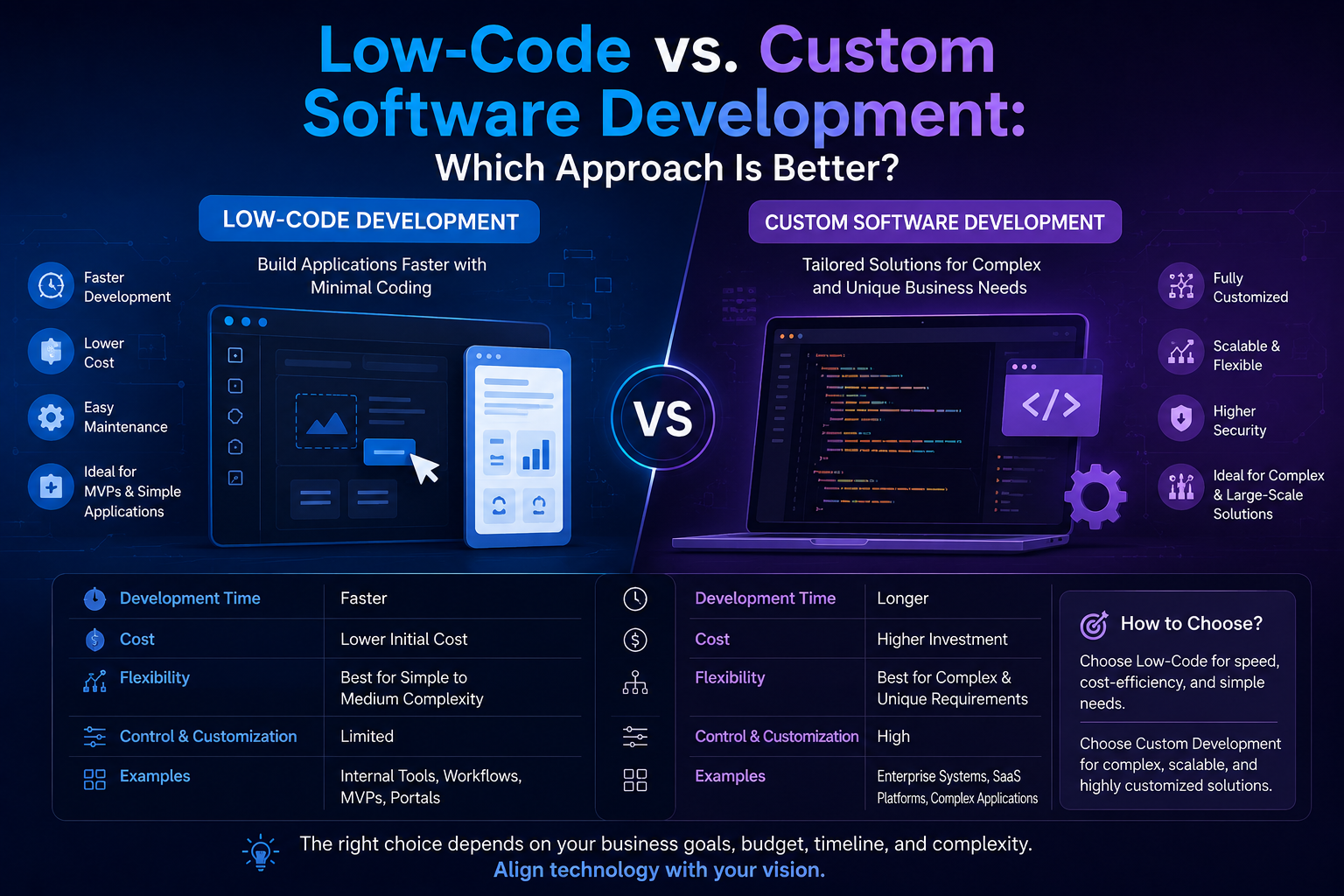
Low-code development focuses on building applications quickly using visual interfaces, pre-built components, workflows, and reusable modules. Custom software development, on the other hand, involves creating software specifically around an organization's unique requirements.
The right choice depends on factors such as project complexity, budget, scalability, security, integration requirements, development timelines, and long-term business goals.
What Is Low-Code Development?
Low-code development uses platforms that allow applications to be created with minimal traditional programming.
Instead of writing every component from scratch, developers and business teams can use:
- Visual development interfaces
- Drag-and-drop components
- Pre-built templates
- Workflow automation
- Reusable modules
- API integrations
- Database connectors
- Automated deployment features
Low-code platforms can be particularly useful for internal business applications, workflow automation, dashboards, forms, approval systems, and relatively straightforward applications.
Advantages of Low-Code Development
Faster Development: Pre-built components can significantly reduce development time.
Lower Initial Development Effort: Organizations may require fewer development resources for straightforward applications.
Rapid Prototyping: Teams can quickly build and test application concepts before making larger investments.
Business User Participation: Non-developers can participate more actively in application development.
Faster Process Automation: Repetitive workflows and internal processes can often be automated quickly.
What Is Custom Software Development?
Custom software development involves designing and building an application specifically for an organization's requirements.
Instead of adapting business processes to the limitations of a platform, the software is designed around the business.
Custom development can include:
- Web applications
- Mobile applications
- Enterprise platforms
- CRM systems
- ERP solutions
- Customer portals
- SaaS products
- AI-powered applications
- Industry-specific software
- API and system integrations
A custom approach gives businesses greater control over the application's architecture, features, user experience, integrations, and future development.
Low-Code vs. Custom Software Development: Key Differences
| Factor | Low-Code Development | Custom Software Development |
|---|---|---|
| Development Speed | Generally faster | Usually requires more time |
| Initial Cost | Often lower | Generally higher |
| Customization | Moderate to high depending on platform | Very high |
| Scalability | Depends on platform and architecture | Can be designed for specific scalability requirements |
| Integration | Strong for supported integrations | Highly flexible |
| User Experience | Limited by platform capabilities | Fully customizable |
| Security Control | Depends on platform | Greater architectural control |
| Maintenance | Platform-dependent | Managed according to the development strategy |
| Technical Expertise | Lower for simple projects | Higher |
| Long-Term Flexibility | Platform-dependent | High |
When Should Businesses Choose Low-Code Development?
Low-code can be a strong option when speed and simplicity are major priorities.
1. The Application Has Straightforward Requirements
Applications such as internal forms, approval workflows, dashboards, basic portals, and simple business process tools may be suitable for low-code platforms.
2. The Business Needs a Quick Solution
If an organization needs to digitize a process quickly, low-code can shorten the development cycle.
For example, a company may need an internal leave management or approval workflow without investing months in a fully custom platform.
3. The Application Is Primarily Internal
Low-code can work well for applications used by employees rather than millions of external customers.
4. The Business Has Limited Development Resources
Organizations with smaller IT teams may use low-code platforms to build and automate certain applications without maintaining a large development team.
5. Rapid Prototyping Is Important
Low-code can help businesses validate an idea before investing in a larger custom development project.
When Should Businesses Choose Custom Software Development?
Custom development becomes more valuable when software is closely connected to business strategy.
1. The Business Has Unique Requirements
If the application needs specialized functionality that standard platforms cannot provide, custom development may be the better choice.
For example, businesses with unique operational workflows may require software designed specifically around their processes.
2. Advanced Integrations Are Required
Complex integration requirements can make platform limitations more apparent.
Custom software can be designed to integrate with:
- ERP systems
- CRM platforms
- Payment gateways
- APIs
- Legacy applications
- Cloud services
- AI systems
- Enterprise databases
3. Scalability Is Critical
Businesses expecting significant growth may want greater control over application architecture and infrastructure.
Custom development allows scalability requirements to be considered from the beginning.
4. The Software Is a Competitive Advantage
If software itself is an important part of the company's competitive strategy, relying entirely on a third-party platform may limit differentiation.
Custom development allows businesses to create unique capabilities that competitors may not easily replicate.
5. Extensive Customization Is Required
When a business needs complete control over workflows, functionality, interface design, permissions, integrations, and data architecture, custom development provides greater flexibility.
Low-Code vs. Custom Development: Cost Considerations
Cost is often one of the first factors businesses consider.
Low-code solutions can have a lower initial development cost because they use pre-built components and reduce the amount of traditional coding required.
However, businesses should consider the total cost of ownership, not only the initial development cost.
Potential low-code expenses may include:
- Platform licensing
- User-based pricing
- Premium integrations
- Data storage
- Vendor-specific services
- Customization
- Migration costs
Custom software generally requires a larger upfront investment, but organizations gain greater control over the application and its technology stack.
The best financial decision depends on the application's expected lifespan, complexity, user base, maintenance requirements, and strategic value.
Scalability and Performance
Scalability is another important consideration.
Low-code platforms can support many business applications effectively, but scalability depends on the platform's architecture, infrastructure, database capabilities, and licensing model.
For applications with highly demanding workloads, complex processing, or specialized performance requirements, custom development may offer greater architectural control.
Businesses should evaluate expected:
- Number of users
- Transaction volume
- Data growth
- API traffic
- Geographic expansion
- Performance requirements
before selecting an approach.
Security and Compliance
Security should never be treated as an afterthought.
Low-code platforms may provide built-in security features, authentication, access controls, and compliance capabilities. However, organizations remain responsible for configuring and governing their applications correctly.
Custom development provides greater control over security architecture, including:
- Authentication
- Authorization
- Encryption
- API security
- Data protection
- Infrastructure
- Logging
- Access management
For businesses operating in highly regulated industries or handling sensitive information, security and compliance requirements should be evaluated carefully before choosing either approach.
Integration Capabilities
Modern businesses rarely operate with a single application.
Software often needs to communicate with other systems.
Low-code platforms generally provide connectors and APIs for popular services, which can make standard integrations faster.
However, highly specialized integrations may require custom development.
If the application must connect with several legacy systems, proprietary APIs, complex databases, or specialized business platforms, custom development may provide greater flexibility.
Can Businesses Use Both Approaches?
Yes.
Businesses do not necessarily have to choose between low-code and custom development for every project.
A hybrid approach can sometimes provide the best balance.
For example:
- Low-code can automate internal approval workflows.
- Custom software can power the company's core business platform.
- APIs can connect both environments.
- Low-code dashboards can provide management reporting.
- Custom applications can handle complex business logic.
This allows businesses to use low-code where speed is valuable while relying on custom development where flexibility and control are essential.
Common Mistakes to Avoid
Choosing Low-Code Only Because It Is Faster
Speed is valuable, but the solution should also meet long-term requirements.
Choosing Custom Development for Every Project
Not every internal workflow requires a completely custom application. Building unnecessary complexity can increase costs and development time.
Ignoring Vendor Dependency
Businesses should understand how difficult it would be to migrate away from a low-code platform if requirements change.
Underestimating Future Requirements
An application that meets today's needs may become a limitation as the business grows.
Focusing Only on Development Cost
Licensing, maintenance, infrastructure, security, upgrades, and future changes should all be included when calculating total cost of ownership.
How to Choose the Right Approach
Businesses can use the following questions as a starting point:
Choose Low-Code When:
- The requirements are relatively straightforward.
- Fast deployment is important.
- The application is primarily internal.
- Standard integrations are sufficient.
- The business wants rapid prototyping.
- Development resources are limited.
Choose Custom Development When:
- Requirements are highly specialized.
- Complex integrations are required.
- The application is customer-facing or business-critical.
- Advanced scalability is required.
- The software provides competitive differentiation.
- Complete control over architecture is important.
Consider a Hybrid Approach When:
- Some processes are simple and others are highly complex.
- The business needs rapid automation alongside strategic custom applications.
- Multiple systems need to work together.
- The organization wants to balance speed, flexibility, and cost.
The Future of Business Application Development
The distinction between low-code and traditional development is becoming less rigid.
Modern development environments increasingly combine visual development, reusable components, APIs, automation, cloud infrastructure, and AI-assisted development.
This means businesses can increasingly choose the development model based on the specific requirements of each application rather than following a single approach for everything.
The most effective strategy is not necessarily choosing the newest technology. It is selecting the technology that provides the right balance of speed, flexibility, security, scalability, and long-term value.
Conclusion
So, which approach is better: low-code or custom software development?
The answer depends on the business problem.
Low-code development can be an excellent choice for straightforward applications, workflow automation, internal tools, and situations where rapid deployment is a priority.
Custom software development is often more appropriate for complex, highly specialized, scalable, and strategically important applications where businesses need complete control.
For many organizations, the most effective strategy may be a combination of both.
Before making a decision, businesses should evaluate their current requirements, future growth plans, integration needs, security requirements, budget, and total cost of ownership.
Clopid Smart Technology Solution helps businesses evaluate technology requirements and build solutions designed around their operational goals. From enterprise applications and CRM/ERP solutions to AI, blockchain, maintenance, and technical support, the right technology strategy can help businesses improve efficiency and prepare for sustainable digital growth.
Explore Clopid Smart Technology Solution: https://www.clopid.com/