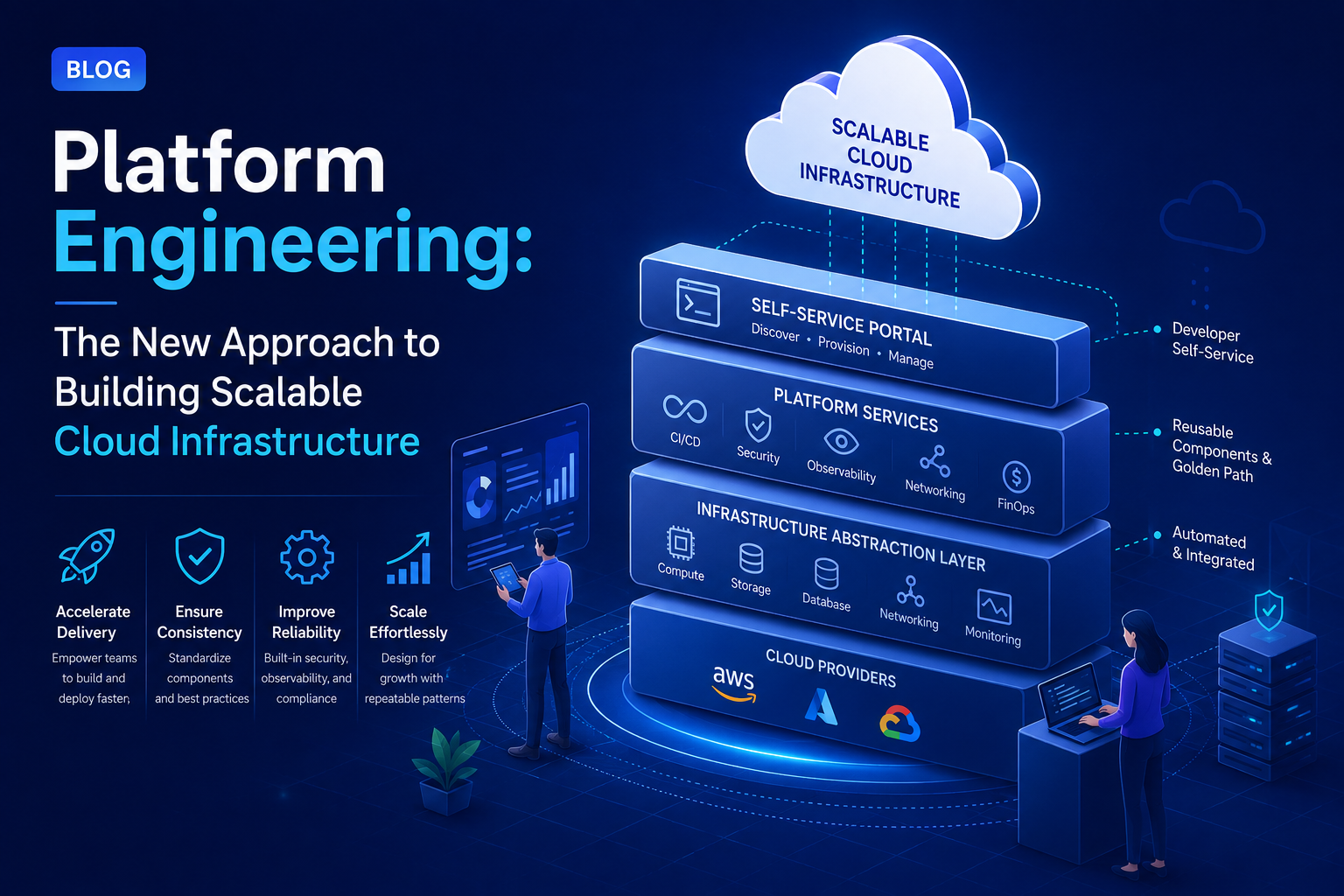
Platform Engineering: The New Approach to Building Scalable Cloud Infrastructure
As businesses accelerate their digital transformation, application development is becoming increasingly dependent on cloud infrastructure.
Modern applications may rely on containers, Kubernetes, microservices, APIs, CI/CD pipelines, cloud services, databases, monitoring platforms and security controls. While these technologies provide flexibility and scalability, they also introduce significant complexity for development and operations teams.
This is where Platform Engineering is becoming an important approach.
Platform engineering focuses on building an internal technology platform that provides developers with standardized, reusable and self-service tools for developing, deploying and operating applications.
Instead of requiring every development team to understand and manage complex infrastructure independently, organizations can provide a centralized platform that simplifies access to the underlying technology.
The result is a more consistent approach to cloud infrastructure, application delivery, security and operational management.
What Is Platform Engineering?
Platform engineering is the practice of designing and maintaining internal developer platforms that provide development teams with the tools, workflows and infrastructure capabilities they need to build and deploy applications efficiently.
An Internal Developer Platform (IDP) can bring together capabilities such as:
- Cloud infrastructure
- Container environments
- Kubernetes
- CI/CD pipelines
- Infrastructure as Code
- Application templates
- Monitoring and observability
- Security controls
- Databases
- Deployment automation
- Access management
The goal is not simply to create another IT layer.
The objective is to provide developers with a simplified and standardized experience while allowing infrastructure and operations teams to maintain control over complex environments.
Why Businesses Are Moving Toward Platform Engineering
Traditional infrastructure management often requires developers to interact with multiple systems and teams.
A developer may need to request:
Infrastructure → Database → Security Access → Deployment Pipeline → Monitoring → Production Deployment
Each step can introduce delays and inconsistencies.
Platform engineering aims to simplify this process.
A developer could instead interact with a self-service platform:
Choose Application Template → Configure Requirements → Deploy → Monitor
The underlying platform handles much of the complexity.
This approach can help organizations improve development velocity while maintaining standardized infrastructure practices.
1. Platform Engineering Reduces Infrastructure Complexity
Cloud environments are powerful, but they can also be complicated.
Developers may need to understand:
- Kubernetes
- Containers
- Networking
- Cloud permissions
- Storage
- Infrastructure configuration
- Deployment pipelines
- Security policies
- Monitoring tools
Platform engineering abstracts much of this complexity behind reusable services and workflows.
Developers can focus more on building business applications instead of manually configuring infrastructure.
This does not eliminate the need for infrastructure expertise. Instead, it allows infrastructure specialists to build the platform while development teams consume standardized capabilities.
2. Self-Service Infrastructure Accelerates Development
One of the major benefits of platform engineering is self-service.
Instead of waiting for infrastructure teams to manually provision resources, developers can use predefined workflows.
For example:
Developer Request
→ Create application environment
→ Provision database
→ Configure deployment pipeline
→ Apply security policies
→ Deploy application
→ Enable monitoring
This can reduce dependency on manual infrastructure processes.
For organizations managing multiple development teams, self-service platforms can become an important mechanism for improving delivery efficiency.
3. Standardization Improves Reliability
Without standardization, different development teams may use different approaches to deployment, security and infrastructure configuration.
One team might use one deployment process while another follows a completely different workflow.
This can create operational challenges.
Platform engineering introduces reusable standards such as:
- Approved application templates
- Standard deployment workflows
- Security policies
- Infrastructure configurations
- Monitoring standards
- CI/CD pipelines
- Environment configurations
This creates greater consistency across development and production environments.
4. Platform Engineering Strengthens DevOps
Platform engineering does not replace DevOps.
Instead, it can help operationalize DevOps practices at scale.
DevOps encourages collaboration between development and operations teams, while platform engineering focuses on creating reusable tools and platforms that make those practices easier to adopt.
For example:
DevOps Principle: Automate software delivery.
Platform Engineering Implementation: Provide developers with a standardized CI/CD pipeline that can be activated through a self-service workflow.
This turns DevOps practices into reusable capabilities rather than requiring every team to build its own process.
5. Security Can Be Integrated Into the Platform
Security should not be treated as a final step before production deployment.
Platform engineering provides an opportunity to integrate security controls directly into development and deployment workflows.
A platform can incorporate:
- Identity and access management
- Security policies
- Secrets management
- Vulnerability scanning
- Compliance checks
- Approved infrastructure configurations
- Audit logging
This approach supports a security-by-design model.
Developers can use secure and approved configurations without needing to manually implement every security control for each application.
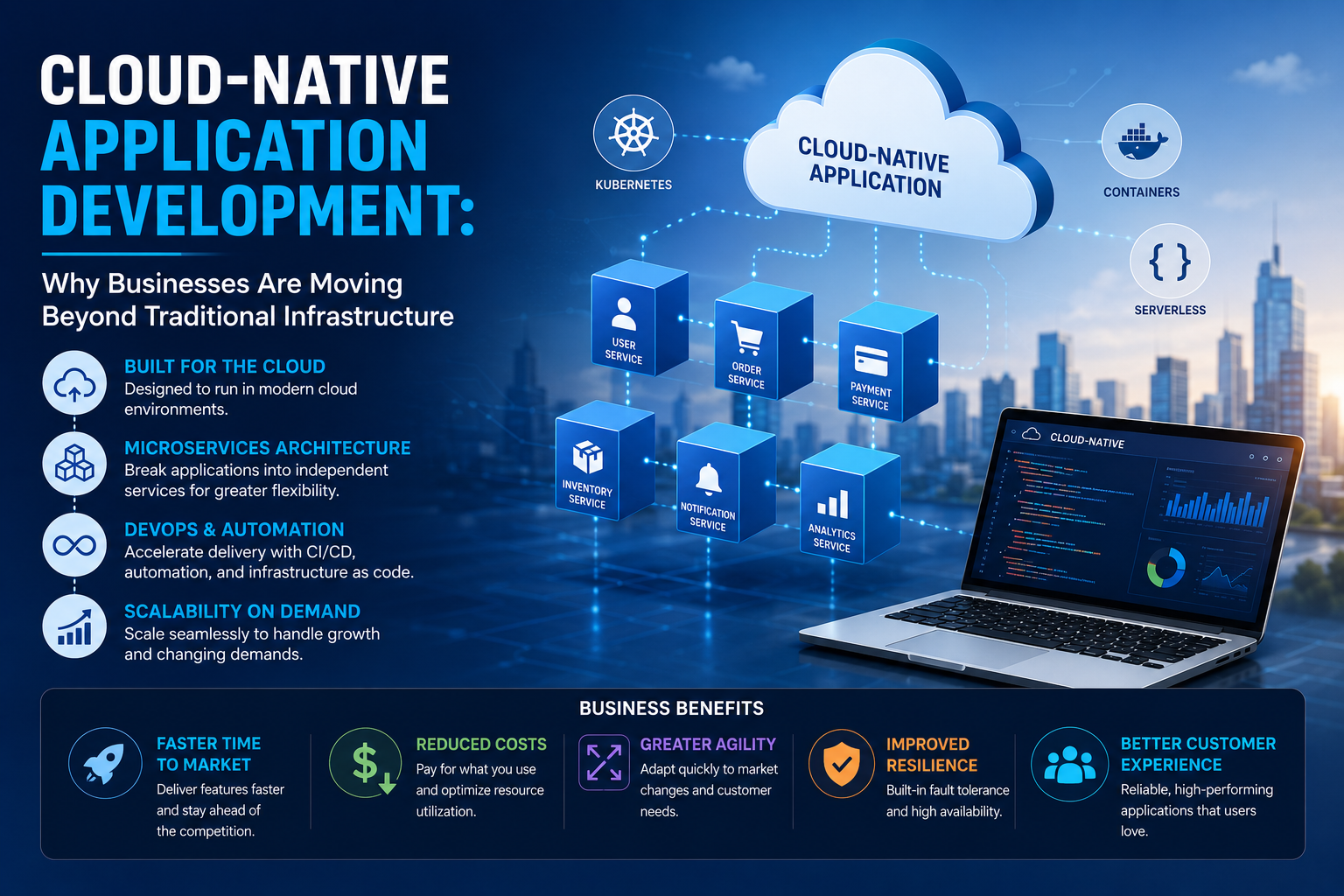
6. Platform Engineering Supports Cloud-Native Development
Platform engineering is particularly valuable for businesses adopting cloud-native architectures.
Modern cloud-native applications commonly use:
- Microservices
- Containers
- Kubernetes
- APIs
- Serverless services
- Automated deployments
- Cloud databases
- Observability tools
Managing these technologies independently across multiple teams can become difficult.
An internal developer platform can provide a consistent interface for accessing these capabilities.
This allows businesses to benefit from cloud-native technologies while reducing unnecessary operational complexity.
7. Automation Becomes a Core Capability
Automation is central to platform engineering.
Instead of manually performing repetitive infrastructure tasks, organizations can automate workflows such as:
Application Provisioning
Automatically create the resources required for a new application.
Environment Creation
Create development, testing and production environments using standardized configurations.
Deployment
Automatically build, test and deploy applications through CI/CD pipelines.
Infrastructure Management
Provision infrastructure through Infrastructure as Code.
Monitoring
Automatically configure application and infrastructure monitoring.
Security
Apply predefined security controls during application deployment.
Automation reduces repetitive work and improves consistency across environments.
8. Platform Engineering Improves Developer Experience
Developer experience is becoming an important consideration for technology organizations.
Developers want to spend their time solving business problems rather than navigating complicated infrastructure processes.
A well-designed platform can provide:
- Self-service workflows
- Simple interfaces
- Reusable templates
- Automated deployments
- Centralized documentation
- Standardized environments
- Integrated monitoring
- Faster access to infrastructure
The platform effectively becomes an internal product designed around developer needs.
This is one of the key differences between simply creating an infrastructure tool and building a successful internal developer platform.
Platform Engineering vs. Traditional Infrastructure
| Traditional Infrastructure | Platform Engineering |
|---|---|
| Manual provisioning | Self-service provisioning |
| Team-specific configurations | Standardized templates |
| Infrastructure complexity exposed to developers | Infrastructure abstraction |
| Manual deployment processes | Automated CI/CD |
| Reactive support | Developer self-service |
| Inconsistent environments | Consistent environments |
| Separate tools and workflows | Integrated platform |
| High operational dependency | Greater developer autonomy |
The goal is not to eliminate infrastructure teams.
Instead, platform engineering enables infrastructure specialists to create reusable systems that support many development teams simultaneously.
Platform Engineering vs. DevOps
These concepts are related but not identical.
DevOps is primarily a culture and set of practices focused on collaboration, automation and continuous software delivery.
Platform Engineering focuses on creating the internal platforms that provide developers with standardized infrastructure and delivery capabilities.
A simple way to understand the relationship is:
DevOps defines the approach.
Platform Engineering builds the platform that enables the approach at scale.
Together, they can help businesses create more efficient software delivery environments.
Key Benefits of Platform Engineering
Businesses adopting platform engineering can target several important benefits.
Faster Application Delivery
Standardized workflows can reduce time spent provisioning and configuring environments.
Greater Developer Productivity
Developers can spend more time building applications and less time managing infrastructure.
Improved Infrastructure Consistency
Reusable templates and workflows can reduce configuration differences.
Stronger Security
Security policies can be integrated into standardized deployment workflows.
Better Scalability
A centralized platform can support multiple teams and applications.
Reduced Operational Complexity
Infrastructure capabilities can be presented through simpler self-service interfaces.
Improved Developer Experience
Teams receive a consistent and predictable development environment.
Challenges of Implementing Platform Engineering
Platform engineering is not simply about purchasing a tool and connecting cloud services.
Organizations need to consider several factors.
Platform Complexity
An overly complicated platform can create the same problems it was designed to solve.
The platform should hide unnecessary complexity rather than introducing another layer of complexity.
Developer Adoption
Developers need to see clear value in the platform.
A platform that does not address real developer needs may have low adoption.
Integration
The platform may need to integrate with existing cloud, security, monitoring, CI/CD and enterprise systems.
Governance
Organizations need clear policies around access, security, compliance and infrastructure management.
Continuous Improvement
An internal developer platform should be treated as a product that evolves based on developer feedback and changing business requirements.
How Businesses Can Start With Platform Engineering
Organizations do not need to build a massive platform from day one.
A phased approach can be more effective.
Step 1: Identify Developer Pain Points
Understand where developers lose the most time during application development and deployment.
Step 2: Select High-Value Workflows
Start with repetitive activities such as application provisioning or deployment.
Step 3: Create Reusable Templates
Develop standardized templates for common application and infrastructure requirements.
Step 4: Introduce Self-Service Capabilities
Allow developers to access approved infrastructure through simple workflows.
Step 5: Integrate Security and Monitoring
Build security, observability and compliance into the platform rather than treating them as separate processes.
Step 6: Measure Platform Performance
Track metrics such as deployment frequency, provisioning time, developer adoption and operational efficiency.
Step 7: Continuously Improve
Gather feedback from developers and improve the platform based on real usage.
The Future of Platform Engineering
As businesses adopt cloud-native applications, AI-powered development and increasingly distributed infrastructure, platform engineering is likely to become an important part of enterprise technology strategy.
The future platform may combine:
Cloud Infrastructure + Automation + AI + Security + Observability + Developer Self-Service
AI can further enhance platform engineering by helping developers provision resources, troubleshoot deployments, optimize infrastructure and understand operational issues.
This could lead to more intelligent platforms where developers interact with infrastructure through simpler, conversational and automated workflows.
However, successful platforms will still require strong architecture, governance and human oversight.
How Clopid Can Help Businesses Build Smarter Technology Solutions
At Clopid Smart Technology Solution, we help businesses leverage modern technologies to improve operational efficiency, scalability and digital capabilities.
Our technology expertise spans CRM, ERP, AI, Blockchain, Maintenance and Technical Support Services, enabling businesses to develop technology environments aligned with their specific operational requirements.
As organizations move toward cloud-native development and modern infrastructure, platform engineering can provide a foundation for more standardized, automated and scalable application delivery.
The right technology strategy can help businesses reduce infrastructure complexity, improve developer productivity and create more resilient digital operations.
Explore how modern technology solutions can support your business transformation with Clopid Smart Technology Solution.
Frequently Asked Questions
What is platform engineering?
Platform engineering is the practice of building internal developer platforms that provide standardized tools, infrastructure and workflows for developing and deploying applications.
What is an Internal Developer Platform?
An Internal Developer Platform, or IDP, provides developers with self-service access to infrastructure, deployment tools, security capabilities and other development resources.
How is platform engineering different from DevOps?
DevOps focuses on collaboration, automation and software delivery practices, while platform engineering focuses on building platforms that make these practices easier to implement consistently at scale.
Why is platform engineering important for cloud-native applications?
Cloud-native environments can involve complex technologies such as containers, Kubernetes, microservices and automated pipelines. Platform engineering can abstract this complexity and provide developers with standardized workflows.
Can platform engineering improve developer productivity?
Yes. Self-service infrastructure, reusable templates and automated workflows can reduce repetitive infrastructure tasks and allow developers to focus more on application development.
Is platform engineering only for large enterprises?
No. While large enterprises may benefit significantly from centralized platforms, smaller organizations can also adopt platform engineering principles to standardize infrastructure and automate repetitive processes.
Conclusion
Platform engineering is becoming a strategic approach to managing the complexity of modern cloud infrastructure.
By combining self-service infrastructure, automation, standardization, security and developer-focused workflows, businesses can create more efficient and scalable software delivery environments.
As cloud-native applications and distributed systems continue to grow, organizations that invest in well-designed internal platforms can reduce operational friction while enabling development teams to deliver applications faster and more consistently.
The future of cloud infrastructure is not only about having more technology. It is about making complex technology easier, safer and more scalable to use.
Clopid — Empowering businesses with intelligent, scalable and modern technology solutions.