Composable ERP: The Future of Flexible Enterprise Software
Enterprise resource planning (ERP) systems have long been the backbone of business operations. They connect essential functions such as finance, supply chain, human resources, inventory, procurement, sales, and customer management through a centralized technology platform.
However, traditional ERP systems can become difficult to adapt as business requirements change.
Organizations today need to respond quickly to new customer expectations, market conditions, technologies, regulations, and operational challenges. A rigid ERP architecture can make these changes expensive and time-consuming.
This is where Composable ERP is gaining attention.
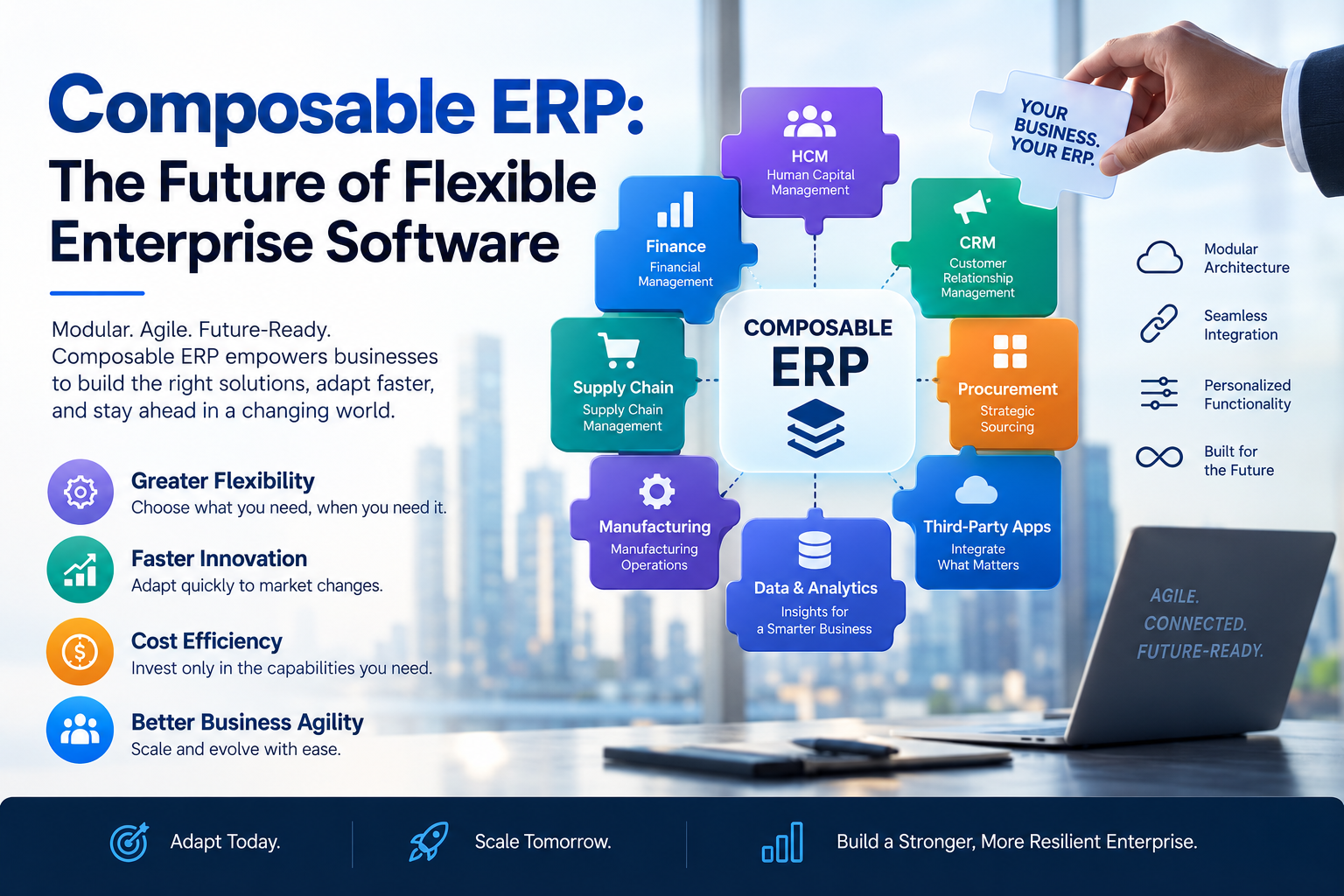
Composable ERP takes a modular approach to enterprise software, allowing organizations to combine different applications, services, APIs, and capabilities according to their specific requirements.
Rather than depending on one large system for everything, businesses can build an ERP ecosystem that evolves with their needs.
What Is Composable ERP?
Composable ERP is an approach to enterprise software architecture where business capabilities are delivered through modular and interoperable components.
Instead of treating ERP as one monolithic application, organizations can combine specialized components that work together through APIs and integrations.
A composable ERP environment may include separate solutions for:
- Finance and accounting
- Procurement
- Inventory management
- Supply chain
- Human resources
- Customer relationship management
- Business intelligence
- E-commerce
- Automation
- Artificial intelligence
These components can be connected to create an integrated enterprise environment.
The key idea is simple:
Businesses should be able to change individual capabilities without having to replace the entire ERP system.
Why Traditional ERP Models Can Become Challenging
Traditional ERP systems provide significant value, but their tightly integrated architecture can sometimes make change difficult.
When a business wants to modify one part of the system, changes may affect other modules and processes.
Common challenges include:
High Customization Costs
Organizations may customize traditional ERP systems extensively to meet unique requirements. Over time, these customizations can make upgrades and maintenance more difficult.
Slow Innovation
Introducing new technologies or capabilities may require significant development work.
Vendor Dependency
Businesses can become heavily dependent on a single ERP provider for functionality, upgrades, integrations, and support.
Complex Upgrades
Large ERP upgrades can require extensive planning, testing, migration, and employee training.
Limited Flexibility
A business may have to adapt its processes to the capabilities and limitations of a particular ERP platform.
Composable ERP aims to address these challenges through modularity and flexibility.
Key Characteristics of Composable ERP
1. Modular Architecture
Composable ERP is built around independent business capabilities.
Organizations can select the modules they need instead of implementing every functionality within a single platform.
For example, a business could use one specialized solution for financial management and another for advanced supply-chain planning while connecting both through APIs.
2. API-First Integration
APIs are essential to composable ERP.
They allow different applications and services to exchange information and work together.
An API-driven architecture can connect ERP components with:
- CRM platforms
- E-commerce systems
- Payment gateways
- Analytics platforms
- AI services
- Customer portals
- Legacy applications
- Cloud services
This creates a more connected enterprise technology ecosystem.
3. Cloud-Native Capabilities
Composable ERP is closely associated with cloud technologies.
Cloud infrastructure can provide organizations with:
- Elastic scalability
- Remote accessibility
- Faster deployment
- Managed infrastructure
- Continuous updates
- Easier integration
Cloud-based components can also make it easier to introduce new capabilities without replacing the entire enterprise environment.
4. Interoperability
Different software components need to work together effectively.
Composable ERP emphasizes interoperability so businesses can connect applications from different vendors and technology ecosystems.
This gives organizations greater freedom when selecting software.
5. Business-Centric Design
Composable ERP focuses on business capabilities rather than simply technical modules.
The goal is to create an environment where technology supports changing business processes.
For example, if a company expands into a new market, it may be able to introduce new capabilities without redesigning the entire ERP environment.
Benefits of Composable ERP
1. Greater Business Agility
Markets can change quickly.
A modular ERP architecture allows businesses to introduce or modify capabilities without making large changes to the entire system.
This can help organizations respond faster to new opportunities and operational requirements.
2. Faster Innovation
Businesses can experiment with new technologies without replacing their complete ERP system.
For example, an organization could integrate an AI-powered analytics solution into its existing ERP ecosystem.
This creates opportunities to adopt emerging technologies more quickly.
3. Improved Scalability
Composable architecture allows organizations to scale individual capabilities based on business demand.
A growing company can add new applications, services, or infrastructure as requirements increase.
This can be particularly valuable for organizations experiencing rapid growth.
4. Reduced Vendor Lock-In
Composable ERP can reduce dependence on a single technology provider.
Businesses can potentially select specialized solutions based on their requirements rather than relying on one vendor for every business function.
This can improve flexibility during technology planning and procurement.
5. Better User Experiences
Different departments may have different technology requirements.
Composable architecture allows businesses to select specialized applications designed around specific user needs.
This can result in more effective workflows and better employee experiences.
6. Easier ERP Modernization
Businesses with legacy ERP systems do not necessarily need to replace everything at once.
They can modernize specific capabilities gradually.
For example:
Legacy ERP → API Integration → Modern Finance Module → Cloud Analytics → AI Automation
This phased approach can reduce disruption and make modernization more manageable.
Composable ERP and Artificial Intelligence
Artificial intelligence is becoming an important component of modern enterprise software.
Composable ERP can make AI adoption easier because modular architecture allows businesses to connect specialized AI services to existing business processes.
Potential applications include:
AI-Powered Forecasting
Businesses can use AI to analyze historical information and improve demand or sales forecasting.
Intelligent Automation
Routine processes such as invoice processing, approvals, and data entry can be automated.
Predictive Analytics
AI can help identify patterns, trends, and potential operational issues.
Intelligent Customer Support
AI-powered assistants can connect with enterprise systems to provide faster access to relevant information.
Fraud and Risk Detection
AI models can analyze transactions and identify unusual patterns that may require further investigation.
Composable architecture can allow organizations to introduce these capabilities without rebuilding their entire ERP environment.
Composable ERP vs. Traditional ERP
| Feature | Traditional ERP | Composable ERP |
|---|---|---|
| Architecture | Often centralized | Modular |
| Customization | Can require extensive customization | Components can be selected and integrated |
| Integration | May depend heavily on vendor ecosystem | API-driven interoperability |
| Scalability | Often platform-wide | Can scale individual components |
| Innovation | May require major upgrades | New capabilities can be integrated incrementally |
| Vendor Dependency | Higher | Potentially lower |
| Modernization | Often complex | Can support phased modernization |
| Flexibility | Relatively limited | High |
The choice does not have to be one or the other. Many organizations may gradually move from traditional ERP architectures toward more modular environments.
Challenges of Implementing Composable ERP
Composable ERP offers flexibility, but it also introduces new responsibilities.
1. Integration Complexity
Connecting multiple applications can become complicated without a strong integration architecture.
Businesses need well-designed APIs, data models, and integration standards.
2. Data Consistency
Different systems must maintain consistent and reliable information.
Data synchronization and governance become increasingly important as the number of applications grows.
3. Security
Every connected application creates another potential security consideration.
Organizations need centralized policies for:
- Identity management
- Authentication
- Authorization
- Encryption
- API security
- Monitoring
4. Governance
Businesses need clear standards for selecting, integrating, monitoring, and replacing individual components.
Without governance, a modular architecture can turn into a fragmented technology environment.
5. Skills Requirements
Managing multiple applications requires expertise in cloud architecture, APIs, integration, security, DevOps, data management, and enterprise architecture.
Best Practices for Adopting Composable ERP
Start With Business Requirements
Do not select technologies simply because they are modular.
First identify the business problems that need to be solved.
Identify Core Business Capabilities
Map important processes such as:
- Finance
- Procurement
- Inventory
- Sales
- HR
- Supply chain
- Customer management
Then determine which capabilities require modernization.
Build an Integration Strategy
Define how applications will exchange data.
An API-first approach can help create consistent integration patterns.
Establish Data Governance
Define standards for data ownership, quality, security, synchronization, and lifecycle management.
Prioritize Security
Security should be built into the architecture from the beginning rather than added after implementation.
Modernize Incrementally
Start with high-value capabilities and expand gradually.
A phased approach can reduce risk while allowing organizations to measure results at each stage.
When Should a Business Consider Composable ERP?
Composable ERP may be worth considering when:
- Existing ERP systems are difficult to customize.
- Business processes change frequently.
- Multiple specialized applications are already being used.
- ERP integrations are becoming difficult to manage.
- The organization wants to adopt AI and automation.
- The business is expanding rapidly.
- Legacy ERP modernization is required.
- Vendor dependency is becoming a concern.
- Different departments require specialized applications.
The right architecture depends on the organization's size, industry, existing technology landscape, budget, and long-term strategy.
The Future of Enterprise Software
Enterprise software is moving toward greater modularity, interoperability, automation, and intelligence.
Businesses increasingly expect technology to adapt to their processes rather than forcing their processes to adapt to rigid software.
Composable ERP supports this shift by allowing organizations to create technology ecosystems that can evolve over time.
As cloud computing, APIs, AI, automation, and data platforms continue to mature, composable architectures may become increasingly important for organizations seeking flexibility and faster innovation.
Conclusion
Composable ERP represents a significant shift in how businesses can approach enterprise software.
Instead of relying on a single monolithic platform for every business function, organizations can create flexible ecosystems built from modular applications and services.
This approach can improve agility, support faster innovation, simplify phased modernization, and provide businesses with greater control over their technology environment.
However, successful implementation requires careful planning. Integration, data governance, security, architecture, and technology management must all be considered.
For businesses evaluating their next-generation ERP strategy, the goal should not simply be to adopt a new technology trend. The objective should be to create an enterprise software environment that can adapt, scale, integrate, and support long-term business growth.
Clopid Smart Technology Solution helps businesses explore modern technology solutions designed around their unique operational requirements. From ERP and CRM solutions to AI, blockchain, maintenance, and technical support, Clopid can help organizations build a more connected and future-ready digital environment.