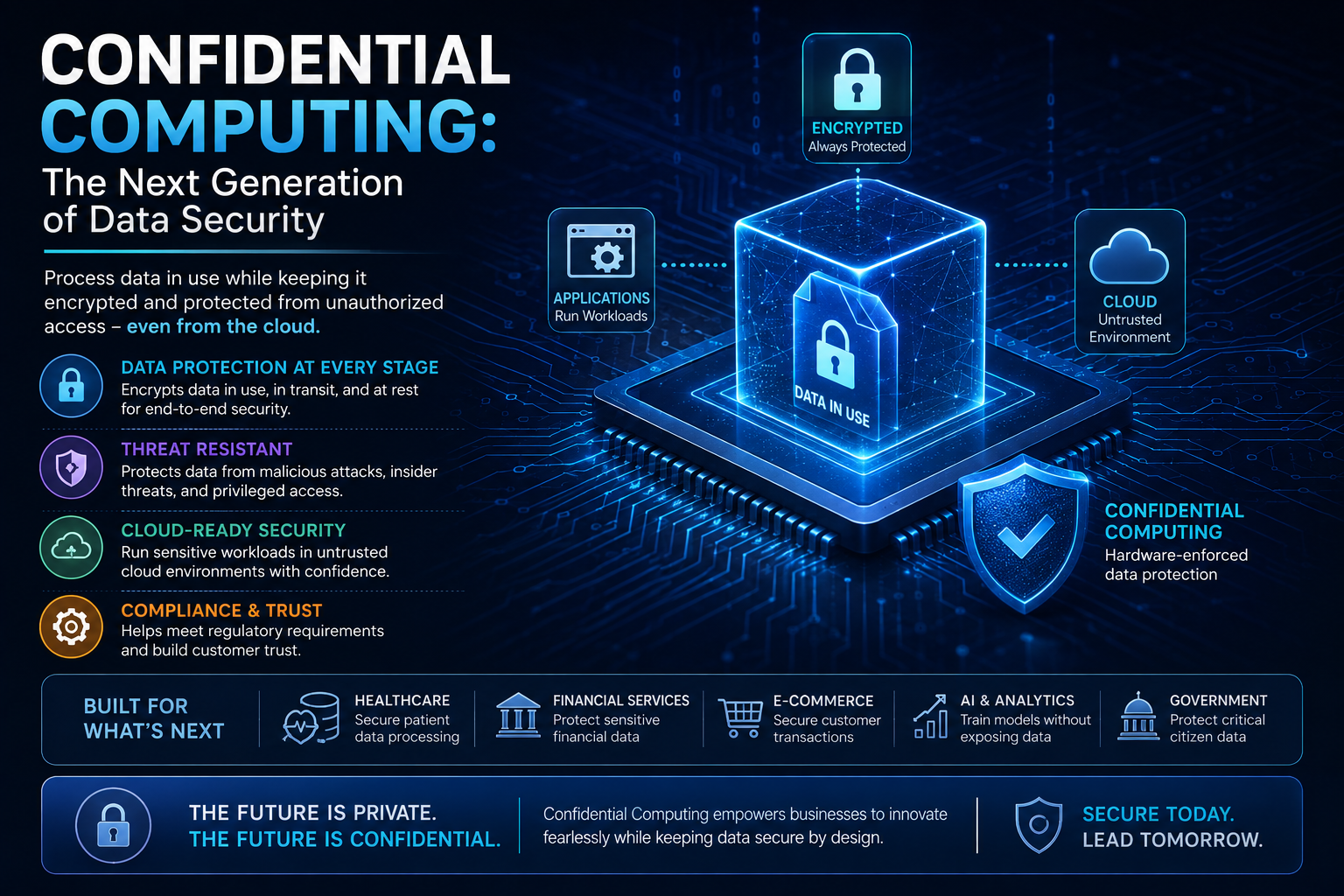
Confidential Computing: The Next Generation of Data Security
Data security has become a strategic priority for businesses operating in an increasingly connected digital environment. Organizations today process sensitive customer information, financial records, intellectual property, business data, and critical workloads across cloud and enterprise infrastructure.
Traditional encryption protects data effectively while it is stored and transmitted. However, data often needs to be decrypted while applications are actively processing it. This creates an important security challenge: how can organizations protect sensitive information even while it is being used?
Confidential Computing addresses this challenge by protecting data while it is being processed.
By using hardware-based trusted execution environments and related security technologies, confidential computing can isolate sensitive workloads and reduce the risk of unauthorized access during computation.
As businesses increasingly adopt cloud services, AI, analytics, and distributed computing, confidential computing is emerging as an important component of modern data-security strategies.
What Is Confidential Computing?
Confidential computing is a security approach designed to protect data in use.
Traditional data protection is often described through three states:
- Data at rest – information stored in databases, servers, or storage systems.
- Data in transit – information moving between systems or networks.
- Data in use – information being actively processed by applications or computing infrastructure.
Encryption has long been used to protect data at rest and in transit. Confidential computing extends protection to the processing stage by using a protected execution environment.
These environments are commonly known as Trusted Execution Environments (TEEs).
A TEE can isolate sensitive workloads from unauthorized access, including access from certain privileged software components, depending on the technology and threat model.
Why Is Confidential Computing Important?
Businesses are increasingly moving workloads to cloud platforms and sharing data across applications, services, and organizations.
This creates new security considerations.
For example, a business may need to process sensitive information using cloud infrastructure while maintaining strict control over the confidentiality of that information.
Confidential computing can help address these concerns by providing an additional layer of protection around sensitive workloads.
It can be particularly relevant for organizations handling:
- Financial information
- Customer data
- Intellectual property
- Healthcare-related information
- Confidential business analytics
- AI and machine learning workloads
- Proprietary algorithms
- Sensitive enterprise applications
How Confidential Computing Works
At a high level, confidential computing uses a protected execution environment to isolate sensitive workloads.
The process can be understood in several stages:
1. Workload Preparation
A sensitive application or workload is prepared to operate within a trusted execution environment.
2. Secure Execution
The workload runs inside the protected environment, where access to its data and computation is restricted according to the security model.
3. Data Processing
Sensitive information can be processed while remaining protected from unauthorized observation outside the protected execution environment.
4. Verification
Some confidential-computing technologies support attestation, allowing a party to verify that a workload is running in an expected trusted environment before sensitive information is provided.
This can help establish greater trust between organizations, applications, and infrastructure.
Confidential Computing vs. Traditional Encryption
Traditional encryption remains essential for protecting information.
However, encryption alone does not solve every security challenge.
| Data State | Traditional Protection | Confidential Computing |
|---|---|---|
| Data at Rest | Encryption | Encryption + workload protection |
| Data in Transit | TLS / encryption | Encryption + secure processing |
| Data in Use | Often decrypted for processing | Designed to protect sensitive workloads during processing |
| Main Purpose | Protect stored/transmitted information | Add protection around sensitive computation |
| Key Technologies | Encryption and key management | TEEs, hardware-based isolation, attestation |
Confidential computing should therefore be viewed as complementary to encryption, not as a replacement for it.
Key Benefits of Confidential Computing
1. Stronger Data Protection
Confidential computing adds protection around sensitive data during processing, helping reduce exposure to certain unauthorized access scenarios.
2. Improved Cloud Security
Businesses can use confidential-computing technologies to add additional security controls when running sensitive workloads in cloud environments.
3. Protection of Intellectual Property
Organizations can protect proprietary algorithms, sensitive datasets, and application logic while processing information.
4. Secure Data Collaboration
Confidential computing can support scenarios where multiple organizations need to collaborate on sensitive data while maintaining stronger confidentiality controls.
5. Support for Compliance Requirements
For organizations operating under strict data-protection and regulatory requirements, confidential computing may contribute to a broader security and compliance strategy.
However, it should not be considered a guarantee of regulatory compliance by itself.
Confidential Computing and Cloud Security
Cloud computing has changed how organizations build and operate applications.
Instead of maintaining all infrastructure internally, businesses often rely on shared cloud infrastructure and managed services.
While cloud providers implement extensive security controls, organizations still need to consider how sensitive workloads are protected during processing.
Confidential computing can add another security layer by isolating sensitive workloads within protected execution environments.
This can be especially valuable for:
- Enterprise applications
- Financial workloads
- Sensitive databases
- AI platforms
- Data analytics
- Multi-tenant environments
- Cross-organization collaboration
Confidential Computing for AI and Machine Learning
The growth of AI has created new data-security challenges.
AI systems often process large amounts of sensitive information, including business data, customer information, proprietary datasets, and intellectual property.
Confidential computing can help organizations explore ways to protect sensitive AI workloads and data during processing.
Potential applications include:
- Protecting proprietary AI models
- Processing sensitive datasets
- Secure AI inference
- Protecting customer information
- Collaborative machine learning
- Privacy-focused analytics
As businesses increasingly deploy AI, protecting both data and models will become an important part of responsible technology adoption.
Confidential Computing in Financial Services
Financial institutions handle highly sensitive information and operate under strict security and regulatory requirements.
Confidential computing can potentially support use cases such as:
- Secure financial analytics
- Fraud detection
- Risk analysis
- Customer-data processing
- Secure collaboration
- Sensitive AI workloads
By adding protection around data during processing, organizations can strengthen their defense-in-depth approach to sensitive financial workloads.
Confidential Computing for Healthcare
Healthcare organizations process sensitive information that requires strong privacy and security controls.
Confidential computing may support secure processing of:
- Patient information
- Research datasets
- Medical analytics
- AI-based healthcare applications
- Collaborative research workloads
The technology can provide an additional security layer when sensitive information needs to be processed in cloud or distributed environments.
Challenges of Confidential Computing
While confidential computing provides promising security benefits, organizations should understand its limitations and implementation challenges.
Hardware and Platform Dependencies
Confidential-computing capabilities depend on compatible hardware, platforms, operating environments, and software.
Performance Considerations
Security mechanisms may introduce some performance or operational overhead depending on the workload and implementation.
Application Compatibility
Existing applications may require architectural changes or optimization to operate effectively within protected environments.
Key Management
Strong encryption and confidential computing still require effective identity, key-management, access-control, and security practices.
Complex Security Architecture
Confidential computing is one part of a broader security architecture. Organizations still need network security, application security, identity management, monitoring, vulnerability management, and incident response.
Is Confidential Computing the Future of Data Security?
Confidential computing is not intended to replace existing cybersecurity technologies. Instead, it extends the security model by addressing a particularly important challenge: protecting sensitive workloads while they are being processed.
As organizations adopt:
- Cloud computing
- Artificial intelligence
- Big data analytics
- Edge computing
- Multi-party data collaboration
- Distributed applications
the ability to protect sensitive computation will become increasingly important.
Confidential computing can therefore become a valuable component of modern security architectures.
How Businesses Can Prepare for Confidential Computing
Organizations interested in confidential computing should begin with a clear assessment of their security requirements.
Step 1: Identify Sensitive Workloads
Determine which applications and datasets require stronger protection during processing.
Step 2: Evaluate Your Infrastructure
Review whether your existing cloud, hardware, and application environments support confidential-computing technologies.
Step 3: Define the Threat Model
Understand what risks you are trying to address and which security boundaries are most important.
Step 4: Integrate With Existing Security
Confidential computing should complement encryption, identity management, access controls, monitoring, and other cybersecurity measures.
Step 5: Start With a Focused Use Case
Organizations can begin with a high-value workload before expanding confidential-computing capabilities across their broader infrastructure.
Final Thoughts
Confidential computing represents an important evolution in data security by addressing the protection of information during processing.
As businesses increasingly rely on cloud infrastructure, AI, analytics, and interconnected digital platforms, protecting data only when it is stored or transmitted may no longer be sufficient for every security scenario.
By combining confidential computing with encryption, identity management, secure application architecture, monitoring, and strong governance, organizations can build a more comprehensive approach to protecting sensitive workloads.
At Clopid Smart Technology Solution, we help businesses explore modern technologies that support secure, scalable, and efficient digital operations. From AI and cloud technologies to enterprise software and advanced security solutions, the right technology strategy can help organizations prepare for evolving digital challenges.
Clopid helps businesses adopt modern technology solutions aligned with their operational requirements, security priorities, and long-term growth objectives.
Frequently Asked Questions
What is confidential computing?
Confidential computing is a technology approach designed to protect sensitive data and workloads while they are being processed, typically using trusted execution environments and hardware-based isolation.
How is confidential computing different from encryption?
Encryption primarily protects data at rest and in transit. Confidential computing focuses on adding protection to sensitive workloads while data is being processed.
Is confidential computing a replacement for cybersecurity?
No. It is an additional security layer that should work alongside encryption, identity management, access controls, network security, monitoring, and other cybersecurity practices.
Can confidential computing improve cloud security?
Yes. It can provide additional protection for sensitive workloads running in supported cloud environments, depending on the implementation and threat model.
Is confidential computing useful for AI?
Yes. Confidential computing can be relevant for protecting sensitive AI datasets, models, and inference workloads, particularly when organizations need stronger confidentiality during processing.
Should every business adopt confidential computing?
Not necessarily. Businesses should first evaluate their data sensitivity, threat model, regulatory requirements, infrastructure, and business use cases to determine whether confidential computing provides meaningful value.