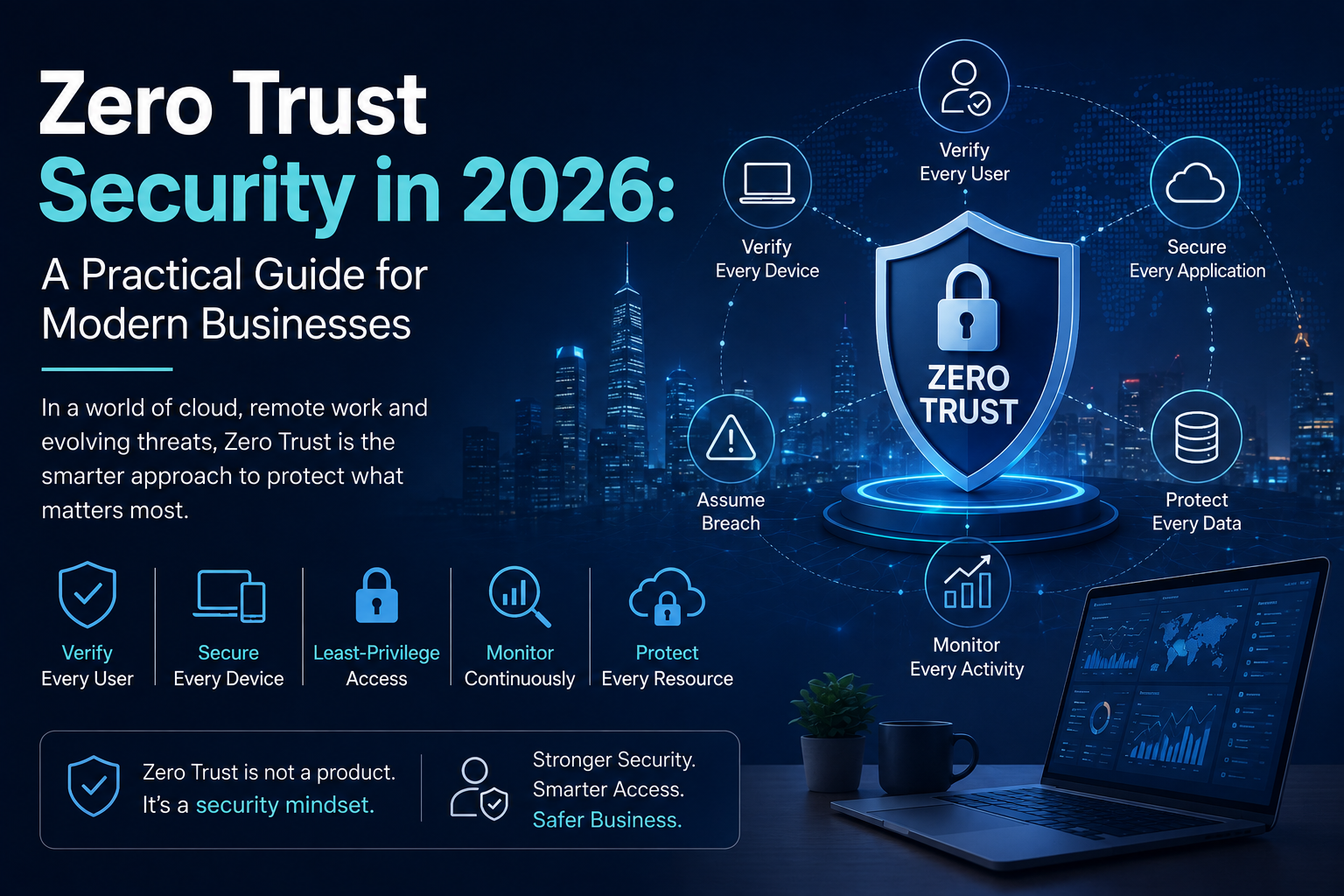
Zero Trust Security in 2026: A Practical Guide for Modern Businesses
As businesses become increasingly cloud-driven, distributed, and dependent on digital systems, traditional security models are no longer enough. Employees work from different locations, applications run across multiple cloud environments, and sensitive business data is accessed from a wide range of devices.
This changing environment has made Zero Trust Security an increasingly important approach to modern cybersecurity.
Zero Trust is based on a simple principle: never automatically trust any user, device, application, or network connection—always verify.
In 2026, organizations are moving beyond perimeter-based security and adopting security architectures designed to continuously verify access, minimize risk, and protect critical business resources.
What Is Zero Trust Security?
Zero Trust is a cybersecurity approach in which access is granted based on continuous verification rather than a user's location or network.
Traditional security often assumes that users inside an organization's network can be trusted. Zero Trust removes this assumption.
Every access request must be evaluated using factors such as:
- User identity
- Device security
- Application and resource
- Location and network context
- Access behavior
- Risk level
- Authentication status
Instead of asking, “Are you inside the network?”, Zero Trust asks, “Should you have access to this resource right now?”
Why Zero Trust Matters in 2026
Modern businesses face a broader and more complex threat landscape.
Remote and hybrid work, cloud applications, SaaS platforms, mobile devices, third-party integrations, and AI-powered applications have expanded the number of potential entry points for attackers.
A compromised password or device can potentially provide access to valuable business systems.
Zero Trust helps organizations reduce this risk by limiting access and continuously evaluating whether access should remain available.
Core Principles of Zero Trust
1. Verify Every User
Authentication should not stop after the initial login.
Organizations can use multi-factor authentication, identity verification, adaptive authentication, and risk-based access policies to ensure that users are properly verified.
2. Verify Every Device
A legitimate user does not automatically mean a secure device.
Zero Trust evaluates device health, security configuration, operating system status, and other signals before granting access to sensitive resources.
3. Apply Least-Privilege Access
Users should receive only the permissions they need to perform their responsibilities.
If an employee only needs access to a particular application or database, they should not automatically receive access to the entire corporate environment.
This limits the potential impact of compromised accounts.
4. Continuously Monitor Activity
Zero Trust is not a one-time security check.
User activity, devices, applications, and access patterns should be monitored continuously. If suspicious behavior is detected, access can be restricted or additional verification can be required.
5. Assume Breach
Zero Trust operates under the assumption that a security breach could happen at any time.
This encourages organizations to limit access, segment resources, monitor activity, and reduce the potential impact of compromised credentials.
Key Technologies Behind Zero Trust
A successful Zero Trust strategy typically combines multiple security technologies.
Identity and Access Management (IAM): Controls who can access business applications and resources.
Multi-Factor Authentication (MFA): Adds additional verification beyond passwords.
Endpoint Security: Helps ensure that devices accessing corporate resources meet security requirements.
Network Segmentation: Separates systems and resources to prevent unauthorized movement across the environment.
Cloud Security: Protects applications, workloads, identities, and data hosted across cloud environments.
Security Analytics: Uses monitoring and analytics to identify unusual activity and potential threats.
Data Protection: Controls access to sensitive information and helps prevent unauthorized data exposure.
Benefits of Zero Trust for Businesses
Stronger Security
Continuous verification and restricted access can reduce opportunities for attackers to move through business systems.
Reduced Attack Surface
Least-privilege access means fewer resources are exposed to each user or device.
Better Protection for Remote Workers
Zero Trust can provide secure access without relying on employees being connected to a traditional corporate network.
Improved Cloud Security
As businesses adopt multiple cloud platforms and SaaS applications, Zero Trust provides a framework for managing access across distributed environments.
Greater Visibility
Continuous monitoring provides organizations with better insight into users, devices, applications, and access behavior.
Better Compliance
A structured approach to identity, access controls, monitoring, and data protection can support organizations in meeting security and compliance requirements.
How Businesses Can Implement Zero Trust
Zero Trust should not be treated as a single product or one-time implementation. It is an ongoing security strategy.
Businesses can begin with the following approach:
Step 1: Identify Critical Assets
Determine which applications, systems, databases, and data require the highest level of protection.
Step 2: Understand Users and Devices
Create visibility into employees, contractors, applications, devices, and other entities that require access.
Step 3: Strengthen Identity Security
Implement strong authentication, MFA, centralized identity management, and appropriate access policies.
Step 4: Introduce Least-Privilege Access
Review existing permissions and remove unnecessary access rights.
Step 5: Segment Critical Resources
Separate sensitive systems so that compromising one resource does not automatically provide access to everything else.
Step 6: Monitor Continuously
Use security monitoring and analytics to identify suspicious activity and respond quickly to potential threats.
Step 7: Improve and Adapt
Security threats continue to evolve. Zero Trust policies should therefore be regularly reviewed and updated based on new risks, technologies, and business requirements.
Common Zero Trust Challenges
Although Zero Trust offers significant security benefits, implementation can present challenges.
Businesses may need to modernize legacy systems, integrate multiple security technologies, manage complex identity environments, and change existing access policies.
Employees may also need time to adapt to stronger authentication and new security procedures.
The key is to implement Zero Trust gradually rather than attempting to transform the entire environment at once.
Zero Trust and the Future of Business Security
The future of cybersecurity is increasingly focused on identity, continuous verification, data protection, and adaptive security.
As organizations adopt cloud platforms, AI applications, remote work models, and connected technologies, the traditional concept of a secure corporate perimeter becomes less relevant.
Zero Trust provides a security framework designed for this new environment.
Organizations that adopt Zero Trust strategically can build security into their digital infrastructure while maintaining the flexibility required for modern business operations.
Zero Trust Security with CLOPID
At CLOPID, we understand that modern businesses need security strategies that support innovation without compromising protection.
A well-designed Zero Trust approach can help organizations strengthen identity security, control access, protect critical resources, and improve visibility across their digital environment.
By combining modern security practices with the right technology and processes, businesses can build a stronger foundation for secure digital growth.
Conclusion
Zero Trust Security is becoming an essential approach for businesses operating in today's distributed digital environment.
Rather than automatically trusting users or devices, Zero Trust continuously verifies access, applies least-privilege principles, monitors activity, and assumes that threats can exist anywhere.
For businesses preparing for the future, Zero Trust is more than a cybersecurity technology—it is a strategic approach to protecting people, applications, devices, and data.
In 2026, building a secure business means moving beyond the idea of a trusted network and toward a model where every access request earns trust through verification.