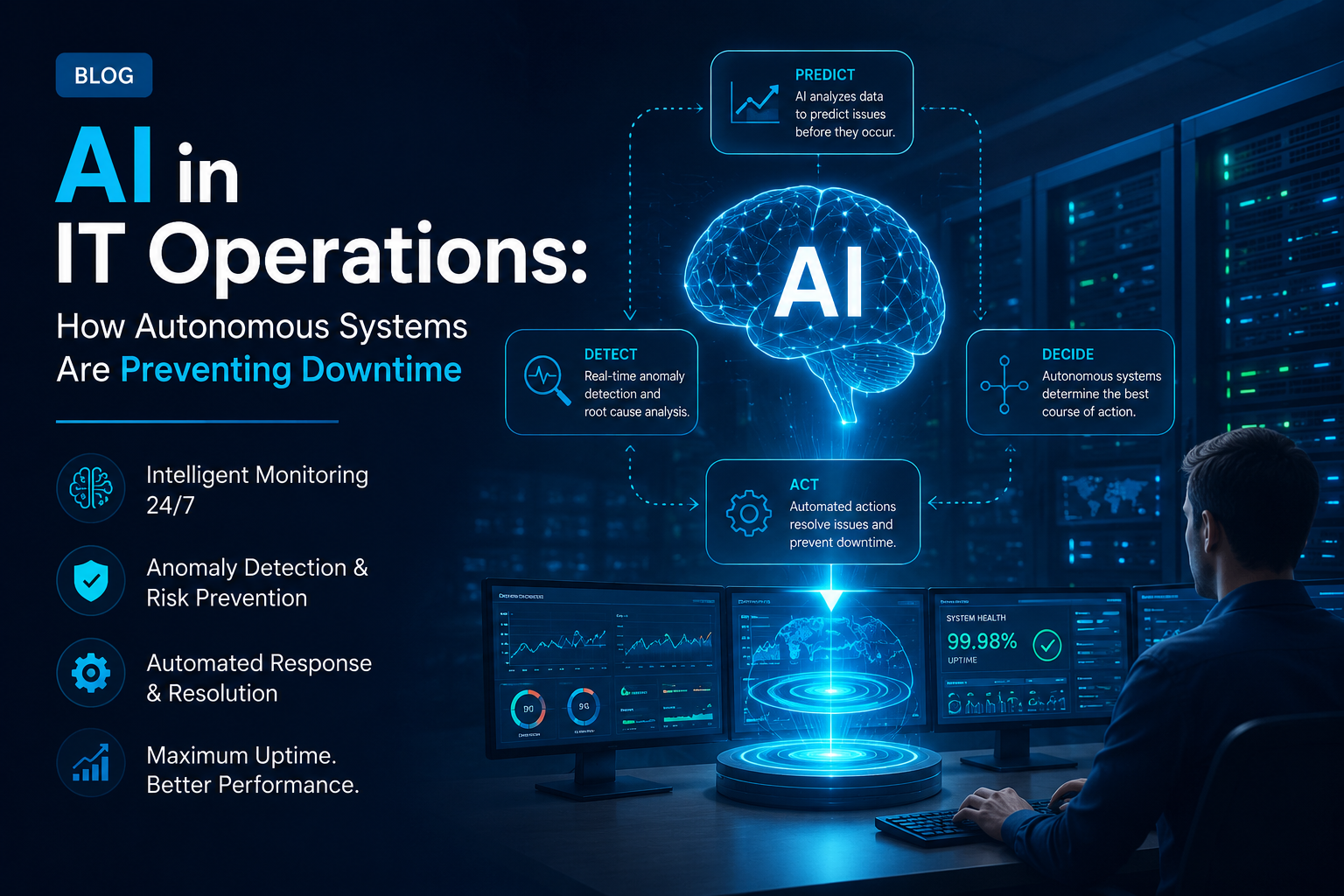
AI in IT Operations: How Autonomous Systems Are Preventing Downtime
For modern businesses, IT infrastructure is at the heart of daily operations. Customer platforms, CRM systems, ERP applications, cloud environments, databases, communication tools and internal business applications all depend on reliable technology.
When these systems experience downtime, the impact can quickly extend beyond the IT department. Employees may lose productivity, customers may face service disruptions and businesses may experience financial and reputational losses.
Traditional IT monitoring typically identifies problems after they occur. However, the rapid evolution of Artificial Intelligence (AI), automation and intelligent infrastructure management is changing this approach.
AI-powered IT operations can analyze massive amounts of operational data, identify unusual patterns, predict potential failures and automate selected responses.
This shift is helping businesses move from reactive IT support to proactive and intelligent IT operations.
What Is AI in IT Operations?
AI in IT Operations involves applying artificial intelligence, machine learning, analytics and automation to monitor and manage IT infrastructure, applications and digital services.
This approach is commonly known as AIOps — Artificial Intelligence for IT Operations.
Traditional IT operations generally follow:
Problem → Alert → Investigation → Diagnosis → Resolution
AI-powered operations aim for:
Monitor → Analyze → Predict → Diagnose → Automate → Resolve
By analyzing information from servers, applications, networks, cloud platforms, databases and business systems, AI can help IT teams identify potential problems earlier and respond more efficiently.
For businesses managing increasingly complex technology environments, this can become an important part of maintaining operational continuity.
Why Businesses Need Intelligent IT Operations
Today's business technology environments are more interconnected than ever.
A typical enterprise environment may include:
- Cloud applications
- CRM and ERP platforms
- APIs and microservices
- Databases
- Virtual machines
- Containers
- Network infrastructure
- Cybersecurity systems
- Third-party integrations
- Employee applications
A problem in one component can potentially affect several connected systems.
For example:
Database performance issue → API slowdown → Application latency → Customer service disruption
Without intelligent monitoring, identifying the original cause can take valuable time.
AI helps businesses analyze these relationships and prioritize the issues that require immediate attention.
1. Predictive Monitoring Helps Identify Problems Early
One of the most important benefits of AI in IT operations is predictive monitoring.
Instead of simply waiting for a server or application to fail, AI systems can analyze historical and real-time information to identify unusual behavior.
This may include:
- CPU utilization
- Memory usage
- Network traffic
- Application response time
- Error rates
- Database performance
- Storage capacity
- User activity
- System logs
- Infrastructure health
For example, if an application consistently shows increasing response times during specific periods, an AI-powered system can identify the pattern and alert the IT team before performance becomes a major issue.
This allows organizations to take preventive action instead of reacting to downtime.
2. AI Reduces Alert Fatigue
IT teams can receive hundreds or even thousands of alerts from different systems.
The challenge is not always detecting problems. It is determining which alerts actually matter.
AI can analyze and correlate related alerts.
For example:
Server Alert
↓
Database Alert
↓
API Alert
↓
Application Performance Alert
Instead of treating these as four unrelated incidents, an intelligent IT operations platform can identify their relationship and help determine the likely underlying problem.
This reduces unnecessary investigation and enables IT professionals to focus on high-priority incidents.
3. AI Accelerates Root-Cause Analysis
Finding the actual cause of an IT incident can take significant time.
AI can analyze logs, system metrics, application behavior and infrastructure dependencies to identify potential root causes.
For example:
Observed problem: Application is responding slowly.
AI analysis may identify:
Database connections reaching capacity → Increased query latency → Application slowdown
Instead of manually reviewing multiple dashboards and logs, IT teams can receive a more focused diagnosis.
This can significantly improve troubleshooting efficiency and reduce the time required to resolve incidents.
4. Autonomous Remediation Can Reduce Downtime
AI-powered IT operations can go beyond detection and diagnosis.
For predefined and low-risk incidents, automated workflows can initiate corrective actions.
Examples include:
- Restarting failed services
- Scaling cloud resources
- Restarting unhealthy containers
- Clearing temporary resources
- Triggering backup or recovery workflows
- Creating support tickets
- Executing approved maintenance procedures
- Escalating unresolved incidents
This concept is often associated with self-healing IT infrastructure.
For example:
AI detects abnormal service behavior
↓
Identifies the issue
↓
Triggers approved remediation workflow
↓
Verifies service recovery
↓
Escalates if recovery fails
This can reduce the amount of time IT teams spend handling repetitive operational problems.
5. AI Agents Are Taking IT Automation Further
Traditional automation generally follows predefined rules.
For example:
IF server utilization exceeds a specific threshold → THEN scale resources.
AI agents can potentially handle more complex operational workflows by analyzing context, determining appropriate actions and interacting with multiple systems.
A controlled AI-driven workflow could involve:
- Detecting an anomaly
- Investigating relevant system data
- Identifying possible causes
- Recommending an action
- Executing an approved workflow
- Checking the outcome
- Escalating when human intervention is required
This represents an important evolution from simple automation toward intelligent and increasingly autonomous IT operations.
For businesses, the objective is not to remove humans from IT operations but to allow technology to handle repetitive tasks while professionals focus on strategic and complex challenges.
6. AI Improves Cloud Infrastructure Management
Cloud environments can change rapidly based on business demand.
Traffic spikes, application launches and seasonal activity can create sudden increases in resource requirements.
AI can help businesses monitor:
- Cloud resource consumption
- Application performance
- Infrastructure capacity
- Workload patterns
- Cost trends
- System availability
Based on historical and real-time data, intelligent systems can help organizations make better decisions about resource allocation and infrastructure scaling.
This can support both performance optimization and cost management.
7. AI Supports Proactive IT Maintenance
Traditional maintenance often happens according to fixed schedules.
AI enables a more data-driven approach.
Instead of asking:
“When is the next scheduled maintenance?”
Businesses can increasingly ask:
“Which system is showing signs of potential failure?”
AI can analyze system behavior and identify components that may require attention.
This can help businesses prioritize maintenance based on actual operational conditions rather than relying solely on predefined schedules.
For organizations with critical applications, proactive maintenance can become an important component of business continuity.
8. AI Can Strengthen Business Continuity
Downtime can affect every part of an organization.
For example:
IT Downtime
→ Reduced employee productivity
→ Delayed business processes
→ Customer service disruption
→ Potential revenue loss
→ Damage to customer trust
AI-powered monitoring and automation can help businesses detect operational risks earlier and respond faster.
When combined with reliable backup, disaster recovery, cybersecurity and technical support strategies, intelligent IT operations can contribute to a more resilient technology environment.
AI + Human Expertise: The Better Approach
Autonomous technology does not mean removing humans from IT operations.
For enterprise environments, human oversight remains important.
AI can handle repetitive and predictable tasks, while IT professionals can oversee high-impact decisions.
| IT Activity | Recommended Approach |
|---|---|
| Alert classification | AI-assisted |
| Alert correlation | Automated |
| Routine diagnostics | AI-assisted |
| Known low-risk issues | Automated remediation |
| Cloud scaling | Policy-based automation |
| Critical production changes | Human approval |
| Security-sensitive actions | Human oversight |
| Major incidents | Human-led |
This approach provides a balance between automation, control and accountability.
Key Benefits of AI-Powered IT Operations
Businesses implementing AI in IT operations can achieve several potential benefits:
Reduced Downtime
Potential issues can be identified before they become major disruptions.
Faster Incident Resolution
AI can accelerate investigation and troubleshooting.
Improved IT Productivity
Automation reduces repetitive operational tasks.
Better Infrastructure Visibility
Data from multiple systems can be analyzed together.
Proactive Maintenance
Businesses can identify potential problems before failure occurs.
Improved Scalability
Intelligent automation can help infrastructure respond to changing demand.
Better Customer Experience
More reliable systems can contribute to consistent digital services.
Operational Efficiency
Businesses can use technology resources more effectively.
Challenges Businesses Should Consider
Although AI-powered IT operations offer significant opportunities, implementation should be carefully planned.
Data Quality
AI requires reliable data. Poor monitoring and incomplete system information can reduce the accuracy of AI-driven insights.
Integration
Businesses often use multiple technology platforms. Integrating monitoring, cloud, CRM, ERP, ITSM and automation systems can require careful architecture.
Security
Autonomous systems may require access to critical infrastructure. Strong identity management and permission controls are therefore essential.
Governance
Businesses should define what AI can monitor, recommend and execute.
Human Oversight
Critical production and security-related actions should have appropriate approval and escalation mechanisms.
The goal should be controlled autonomy, not unrestricted automation.
How Businesses Can Start With AI in IT Operations
Organizations do not need to completely transform their IT environment overnight.
A phased strategy can be more practical.
Step 1: Strengthen Monitoring
Establish reliable observability across applications, infrastructure and cloud environments.
Step 2: Identify Repetitive IT Problems
Find tasks that consume significant IT resources but follow predictable processes.
Step 3: Introduce AI-Assisted Monitoring
Use AI to analyze alerts, detect anomalies and identify potential issues.
Step 4: Automate Low-Risk Workflows
Start with tested remediation procedures where the potential impact is limited.
Step 5: Establish Governance
Define permissions, approval processes, audit trails and rollback procedures.
Step 6: Move Toward Intelligent Automation
Once AI-assisted processes demonstrate reliability, businesses can gradually expand automation into more advanced operational workflows.
The Future of IT Operations
The future of IT operations is moving beyond simple monitoring.
The next generation of enterprise IT will increasingly combine:
AI + Automation + Cloud + Observability + Intelligent Decision-Making
Instead of waiting for systems to fail, businesses can increasingly identify risks earlier, understand operational patterns and automate appropriate responses.
AI agents may further extend these capabilities by helping IT teams investigate incidents, coordinate workflows and execute approved operational tasks.
However, successful adoption will depend on more than technology alone. Businesses will need strong infrastructure, reliable data, cybersecurity, governance and clearly defined human oversight.
How Clopid Can Help Businesses Build Smarter Technology Environments
At Clopid Smart Technology Solution, we understand that modern businesses need technology that is reliable, scalable and aligned with their operational objectives.
Clopid provides technology solutions across CRM, ERP, AI, Blockchain, Maintenance and Technical Support Services, helping organizations adopt modern technologies to improve business processes and operational efficiency.
As AI continues to transform IT operations, businesses can benefit from combining intelligent automation with robust enterprise technology solutions.
Whether the goal is improving business processes, modernizing infrastructure, strengthening technical support or introducing AI-driven capabilities, the right technology strategy can help organizations build a more resilient digital environment.
The future of IT operations is not simply about responding to problems faster. It is about using intelligent technology to identify, prevent and resolve problems before they become business disruptions.
Frequently Asked Questions
What is AI in IT Operations?
AI in IT Operations involves using artificial intelligence, machine learning and automation to monitor, analyze and manage IT infrastructure and applications.
What is AIOps?
AIOps stands for Artificial Intelligence for IT Operations. It combines AI, analytics and automation to improve monitoring, incident management, troubleshooting and IT operations.
Can AI prevent IT downtime?
AI cannot guarantee zero downtime, but predictive monitoring, anomaly detection and automated remediation can help businesses identify and address potential issues earlier.
What is autonomous IT?
Autonomous IT refers to technology environments where AI and automation can monitor systems, analyze incidents and perform predefined operational tasks with limited human intervention.
Is AI suitable for enterprise IT operations?
Yes. AI can support enterprise IT operations by improving monitoring, incident analysis, automation, infrastructure management and proactive maintenance. However, implementation should include appropriate governance and human oversight.
How can businesses start using AI in IT operations?
Businesses can begin with monitoring and anomaly detection, then gradually introduce AI-assisted diagnostics and low-risk automation before moving toward more autonomous workflows.
Conclusion
AI is transforming IT operations from reactive monitoring into proactive and increasingly intelligent infrastructure management.
Through predictive monitoring, intelligent alert correlation, automated remediation and AI-assisted troubleshooting, businesses can improve system reliability while reducing the operational burden on IT teams.
For organizations looking toward the future, the opportunity is clear: build IT environments that do more than respond to problems—they anticipate them.
Clopid Smart Technology Solution — Empowering businesses with smarter, scalable and technology-driven solutions.
Ready to explore how AI and intelligent automation can improve your business operations? Connect with Clopid to discuss your technology requirements.