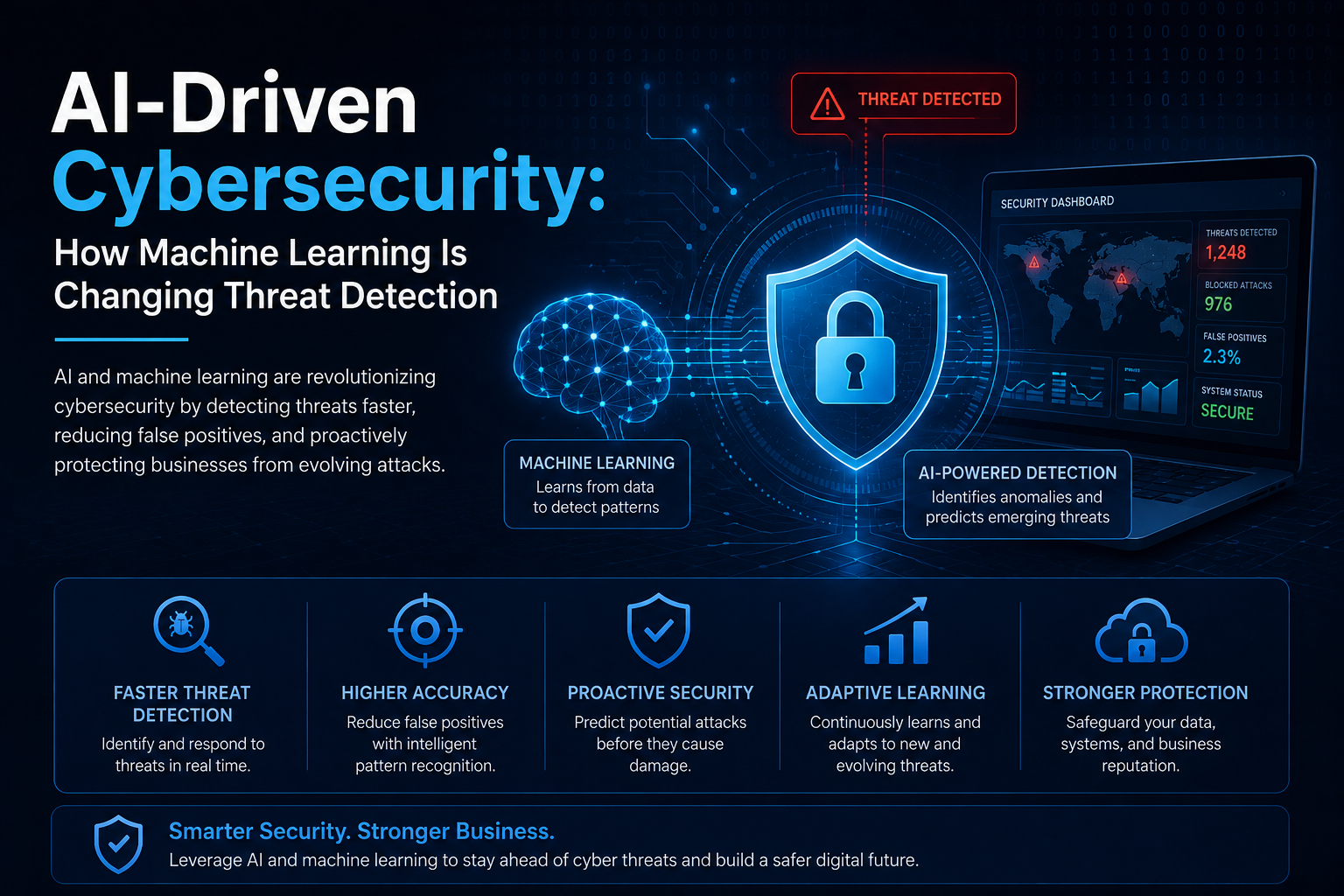
AI-Driven Cybersecurity: How Machine Learning Is Changing Threat Detection
Cybersecurity threats are becoming more sophisticated, frequent, and difficult to detect using traditional security approaches alone. Businesses now operate across cloud platforms, remote environments, connected devices, APIs, enterprise applications, and increasingly complex digital ecosystems.
As the attack surface expands, organizations need security systems capable of analyzing large amounts of data and identifying suspicious activity quickly.
This is where Artificial Intelligence and Machine Learning are transforming modern cybersecurity.
AI-driven cybersecurity can help organizations identify unusual behavior, detect potential threats, automate security analysis, and support faster incident response. Instead of relying exclusively on predefined rules and known threat signatures, machine learning systems can analyze patterns and identify activity that may indicate previously unknown or evolving threats.
For modern businesses, AI is becoming an important component of a broader cybersecurity strategy.
What Is AI-Driven Cybersecurity?
AI-driven cybersecurity refers to the use of artificial intelligence, machine learning, behavioral analytics, and automation to improve the detection, investigation, and response to cybersecurity threats.
Traditional security systems often rely heavily on predefined rules or known signatures. While these remain valuable, attackers continuously develop new techniques.
Machine learning introduces an additional layer of intelligence by analyzing patterns in data and identifying activity that differs from expected behavior.
AI-driven security can analyze:
- Network traffic
- Login activity
- User behavior
- Endpoint activity
- Application logs
- Cloud events
- Email activity
- Authentication attempts
- System events
The goal is to identify potential threats earlier and help security teams respond more effectively.
Why Traditional Threat Detection Is No Longer Enough
Traditional cybersecurity technologies remain essential, but modern environments create several challenges.
Large Data Volumes
Businesses generate enormous amounts of security data every day. Manually analyzing every event is impractical.
Evolving Attack Techniques
Cybercriminals continuously modify their methods to bypass established security controls.
Distributed IT Environments
Cloud infrastructure, remote work, SaaS platforms, APIs, and connected devices make traditional network boundaries less effective.
Alert Overload
Security teams may receive thousands of alerts, many of which may not represent serious threats.
AI and machine learning can help prioritize relevant activity and reduce the burden on security teams.
How Machine Learning Improves Threat Detection
1. Behavioral Analysis
Machine learning can establish patterns of normal activity for users, devices, and systems.
For example, if an employee normally logs in from one location during business hours but suddenly shows unusual authentication behavior, the system can identify the activity as potentially risky.
Behavioral analysis can help detect:
- Unusual login patterns
- Abnormal data access
- Suspicious account activity
- Unexpected application usage
- Unusual network behavior
2. Anomaly Detection
Machine learning can identify deviations from expected system behavior.
Instead of searching only for known malicious signatures, anomaly detection can highlight unusual events that may require investigation.
This is particularly useful for identifying emerging or previously unseen threats.
3. Malware Detection
AI can assist security platforms in identifying potentially malicious files and applications by analyzing behavioral and structural characteristics.
Machine learning models can evaluate patterns associated with malicious activity and help security teams investigate suspicious files more quickly.
4. Phishing Detection
Phishing attacks continue to be a major cybersecurity concern.
AI-powered security systems can analyze factors such as:
- Email content
- Sender behavior
- Links
- Domain characteristics
- Message patterns
- User interactions
This can help identify suspicious communications before they lead to compromised accounts or data exposure.
5. Identity and Account Protection
Compromised credentials are frequently used to gain unauthorized access.
AI can analyze authentication activity and identify unusual patterns such as:
- Multiple failed login attempts
- Unusual access times
- Unexpected geographic patterns
- Abnormal application access
- Sudden privilege changes
Security teams can then apply additional verification or restrict access when appropriate.
AI and Real-Time Threat Detection
One of the major advantages of AI-driven cybersecurity is the ability to process large volumes of security information quickly.
A traditional investigation may require analysts to manually correlate information from different systems.
AI-driven platforms can assist by correlating signals across:
- Endpoints
- Networks
- Identity systems
- Cloud environments
- Applications
- Security logs
This can help security teams identify relationships between seemingly unrelated events.
For example, an unusual login followed by abnormal file access and unexpected data transfer may represent a more significant security incident when analyzed together than when each event is viewed independently.
AI-Powered Security Operations
Security Operations Centers generate and analyze large volumes of security events.
AI can assist security teams with several activities.
Alert Prioritization
AI can help rank alerts based on potential risk and context.
Automated Investigation
AI systems can gather relevant information from multiple security sources to support investigations.
Threat Correlation
Machine learning can identify relationships between different events and security signals.
Incident Response Assistance
AI can recommend or, under carefully controlled conditions, automate selected response actions.
Security Reporting
AI can summarize complex security incidents and generate understandable reports for technical and business stakeholders.
AI in Endpoint Security
Endpoints such as laptops, desktops, and mobile devices are common targets for attackers.
AI-powered endpoint security can monitor system activity and identify suspicious behavior.
Potential signals include:
- Unusual processes
- Unexpected software execution
- Abnormal file activity
- Suspicious network connections
- Privilege changes
- Unusual system behavior
This can help organizations detect threats closer to the point where they occur.
AI and Cloud Security
As organizations increasingly adopt cloud infrastructure, security teams need visibility across dynamic environments.
AI can analyze cloud activity to identify:
- Suspicious authentication
- Misconfigured resources
- Abnormal API activity
- Unusual data access
- Unexpected privilege changes
- Potential account compromise
This makes AI particularly useful for organizations operating complex hybrid and multi-cloud environments.
Benefits of AI-Driven Cybersecurity
Faster Threat Detection
AI can analyze security events rapidly, helping organizations identify suspicious activity sooner.
Improved Security Visibility
Machine learning can correlate information from multiple sources and provide a broader view of potential threats.
Reduced Alert Fatigue
AI-assisted prioritization can help security teams focus on the most important alerts.
Faster Incident Response
Automated analysis and response workflows can reduce the time required to investigate certain security events.
Detection of Unknown Threats
Behavior-based machine learning approaches can identify anomalies that may not match known threat signatures.
Improved Security Operations
AI can automate repetitive analysis tasks, allowing cybersecurity professionals to spend more time on complex investigations and strategic security improvements.
Challenges of AI-Driven Cybersecurity
AI can strengthen cybersecurity, but it is not a replacement for experienced security teams or foundational security controls.
False Positives
AI systems may sometimes identify legitimate activity as suspicious.
False Negatives
No detection system can guarantee that every threat will be identified.
Data Quality
Machine learning systems depend on appropriate and reliable data. Poor-quality data can reduce effectiveness.
Model Security
AI systems themselves can become targets for manipulation or attack.
Lack of Human Context
Security decisions often require business and operational context that automated systems may not fully understand.
Implementation Complexity
Integrating AI with existing security platforms, applications, identity systems, and infrastructure requires careful planning.
AI vs. Traditional Cybersecurity
AI-driven cybersecurity should not be viewed as a complete replacement for traditional security.
Instead, modern security environments typically combine multiple layers.
| Traditional Security | AI-Driven Security |
|---|---|
| Signature-based detection | Behavioral analysis |
| Rule-based alerts | Machine learning models |
| Known threat identification | Anomaly detection |
| Manual investigation | Automated investigation assistance |
| Static policies | Adaptive risk analysis |
| Human-led correlation | AI-assisted event correlation |
The strongest security strategy combines established controls with modern AI capabilities.
How Businesses Can Adopt AI-Driven Cybersecurity
Organizations should take a structured approach.
Step 1: Assess the Current Security Environment
Identify existing security technologies, vulnerabilities, data sources, and monitoring capabilities.
Step 2: Identify High-Value AI Use Cases
Focus on areas where AI can deliver measurable improvements, such as alert prioritization, anomaly detection, endpoint monitoring, or phishing detection.
Step 3: Integrate Security Data
Connect relevant sources such as endpoint platforms, identity systems, cloud environments, network infrastructure, and security logs.
Step 4: Establish Strong Access Controls
AI should operate within clearly defined permissions and security policies.
Step 5: Maintain Human Oversight
High-impact security decisions should include appropriate human review, especially during the early stages of implementation.
Step 6: Continuously Evaluate Performance
Monitor detection quality, false positives, response times, and overall security outcomes.
The Future of AI in Cybersecurity
The relationship between AI and cybersecurity will continue to evolve.
AI systems are increasingly being used not only to detect threats but also to assist with investigation, security analysis, vulnerability management, and response workflows.
At the same time, attackers are also using AI to improve phishing, social engineering, malware development, and other attack techniques.
This means organizations need to treat AI security as an ongoing process.
Future cybersecurity environments will likely combine:
- AI-powered threat detection
- Behavioral analytics
- Automated response
- Identity-centric security
- Zero Trust principles
- Cloud security
- Endpoint protection
- Human expertise
The organizations that combine these capabilities effectively will be better positioned to respond to an increasingly complex threat landscape.
How Clopid Can Support Modern Cybersecurity
Clopid Smart Technology Solution helps businesses explore modern technology solutions designed around security, efficiency, and digital transformation requirements.
AI-driven cybersecurity can complement Clopid's broader technology capabilities by helping businesses strengthen visibility, monitoring, automation, and protection across their digital environments.
A practical cybersecurity strategy can include:
- Security assessment
- Identity and access management
- AI-assisted monitoring
- Endpoint security
- Cloud security
- Threat detection
- Security automation
- Technical support and maintenance
The objective is to build security into the technology environment rather than treating it as an isolated function.
Conclusion
AI and machine learning are changing how businesses approach cybersecurity.
By analyzing behavioral patterns, identifying anomalies, correlating security events, prioritizing alerts, and supporting incident response, AI-driven security can help organizations respond to threats more efficiently.
However, AI should be part of a broader cybersecurity strategy that includes strong identity management, secure infrastructure, endpoint protection, data security, Zero Trust principles, monitoring, and human expertise.
For modern businesses, the goal is not simply to deploy AI. It is to use AI strategically to build a more proactive, intelligent, and resilient cybersecurity environment.
Clopid Smart Technology Solution helps businesses leverage modern technology to strengthen digital operations and prepare for the evolving cybersecurity landscape.
Frequently Asked Questions
What is AI-driven cybersecurity?
AI-driven cybersecurity uses artificial intelligence and machine learning to analyze security data, identify suspicious activity, detect anomalies, prioritize threats, and support incident response.
How does machine learning detect cyber threats?
Machine learning analyzes patterns in security data and can identify behavior that differs from expected activity. This can help detect both known and potentially unknown threats.
Can AI replace cybersecurity professionals?
No. AI can automate repetitive analysis and support security teams, but human expertise remains important for investigation, decision-making, strategy, and managing complex incidents.
Can AI detect zero-day threats?
AI-based behavioral and anomaly detection can potentially identify suspicious activity associated with previously unknown threats, but no technology can guarantee detection of every zero-day attack.
Is AI cybersecurity suitable for small businesses?
Yes. Small and medium-sized businesses can benefit from AI-assisted security capabilities, particularly managed security monitoring, endpoint protection, identity security, and automated threat detection.
About Clopid Smart Technology Solution
Clopid Smart Technology Solution helps businesses leverage modern technologies to improve digital operations, security, and technology infrastructure.
With capabilities across AI, CRM, ERP, Blockchain, Maintenance, and Technical Support Services, Clopid focuses on practical technology solutions aligned with evolving business requirements.
Looking to strengthen your organization's cybersecurity? Connect with Clopid to explore technology and security solutions designed for your business.