Microservices vs. Monolithic Architecture: Which Is Right for Your Business?
Introduction
Choosing the right software architecture is one of the most important decisions businesses make when developing or modernizing digital applications.
Two widely used approaches are Monolithic Architecture and Microservices Architecture. Both can support reliable and scalable applications, but they are designed for different business requirements.
A monolithic application typically operates as a single integrated unit, while a microservices architecture divides an application into smaller, independently deployable services.
The right choice depends on factors such as business size, application complexity, development resources, scalability requirements, deployment needs, and long-term technology strategy.
For businesses working with Clopid Smart Technology Solution, understanding these differences can help establish a stronger foundation for software development and digital transformation initiatives.
What Is Monolithic Architecture?
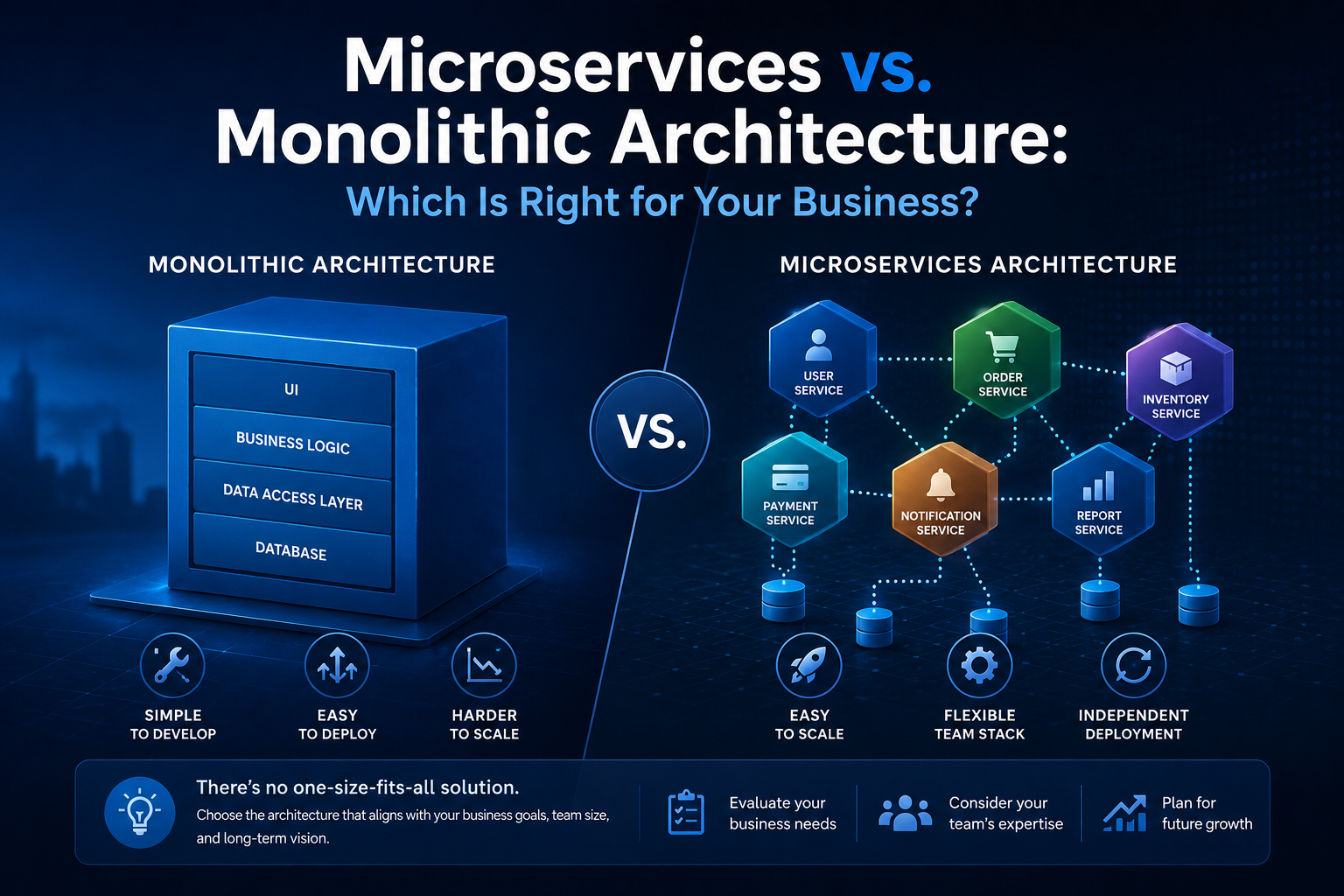
A monolithic application is built as a single software unit. Its major components, such as the user interface, business logic, and data-access layer, are generally developed and deployed together.
For example, an e-commerce application may contain:
- User management
- Product catalog
- Shopping cart
- Order processing
- Payment functionality
- Inventory management
All of these components can exist within one application.
Advantages of Monolithic Architecture
Monolithic architecture can be highly effective for certain applications, particularly when the system is relatively small or the development team is limited.
Key benefits include:
- Simpler initial development
- Easier deployment
- Straightforward testing
- Simpler local development
- Lower infrastructure complexity
- Easier debugging in smaller applications
For a startup building an initial product, a well-designed monolithic architecture can sometimes provide a faster path to market.
What Is Microservices Architecture?
Microservices architecture divides an application into multiple smaller services.
Each service is responsible for a specific business capability and can potentially be developed, deployed, and scaled independently.
For example, an enterprise application could separate:
- Authentication Service
- Customer Service
- Product Service
- Order Service
- Payment Service
- Notification Service
These services communicate through APIs or messaging systems.
Instead of modifying and deploying the entire application for every change, development teams can update individual services when appropriate.
Microservices vs. Monolithic Architecture
The biggest difference is how application components are structured and managed.
| Factor | Monolithic Architecture | Microservices Architecture |
|---|---|---|
| Application structure | Single application | Multiple independent services |
| Deployment | Usually deployed together | Services can be deployed independently |
| Scalability | Often scales as a whole | Individual services can be scaled |
| Development | Simpler initially | More complex |
| Infrastructure | Lower complexity | Higher complexity |
| Testing | Generally simpler | Requires distributed testing |
| Maintenance | Can become difficult as application grows | Services can be maintained independently |
| Team structure | Suitable for smaller teams | Works well with multiple specialized teams |
| Fault isolation | Limited | Better service-level isolation |
| Technology flexibility | More centralized | Services can use different technologies where appropriate |
When Monolithic Architecture Makes Sense
A monolithic architecture can be the right choice when simplicity and speed are major priorities.
1. Small or Medium-Sized Applications
If an application has limited functionality and relatively low complexity, microservices may introduce unnecessary overhead.
2. Small Development Teams
Teams with a few developers may find a monolithic system easier to understand, develop, test, and maintain.
3. Early-Stage Products
Businesses validating a new product or business model may benefit from building a simpler architecture first.
4. Limited Infrastructure Requirements
If an application does not require independent scaling or frequent service-level deployments, a monolithic approach can be practical.
5. Faster Initial Development
A well-structured monolith can reduce the number of infrastructure and communication components required during the early stages of development.
When Microservices Architecture Makes Sense
Microservices can be valuable when applications become larger, more complex, or require independent scalability.
1. Large Enterprise Applications
Organizations managing complex business systems may benefit from dividing functionality into independently managed services.
2. Independent Scaling Requirements
If one component experiences significantly higher demand than others, microservices allow that service to scale independently.
3. Multiple Development Teams
Large engineering organizations can assign different teams to specific services or business capabilities.
4. Frequent Independent Releases
Businesses that need to release features frequently can benefit from independently deployable services.
5. Complex Digital Ecosystems
Applications that integrate multiple systems, APIs, platforms, and business capabilities can benefit from a service-oriented architecture.
Key Benefits of Microservices
Independent Deployment
Teams can deploy individual services without necessarily redeploying the entire application.
Flexible Scaling
Resources can be allocated to services based on their specific workloads.
Improved Fault Isolation
A problem in one service can potentially be isolated without bringing down the entire application, depending on the system design.
Team Independence
Different teams can work on separate services with clearer ownership and development responsibilities.
Technology Flexibility
Organizations can choose technologies appropriate for individual services where there is a strong business or technical reason to do so.
Challenges of Microservices
Microservices are not automatically better than monolithic architecture.
They introduce additional complexity that businesses need to manage.
Distributed System Complexity
Services need to communicate over networks, which introduces latency, reliability, and communication challenges.
Monitoring Requirements
Organizations need centralized logging, monitoring, tracing, and alerting to understand what is happening across multiple services.
Deployment Complexity
Managing numerous services requires mature CI/CD processes and infrastructure automation.
Data Management
Maintaining data consistency across distributed services can be more challenging than managing data within a single application.
Higher Operational Requirements
Microservices typically require stronger DevOps practices, containerization, orchestration, monitoring, security, and automation.
Can a Monolithic Application Be Scaled?
Yes.
A common misconception is that monolithic applications cannot scale.
A well-designed monolithic application can support significant workloads through techniques such as:
- Horizontal scaling
- Load balancing
- Database optimization
- Caching
- Content delivery networks
- Performance optimization
- Infrastructure scaling
The challenge arises when different parts of the application need to scale independently or when the codebase becomes increasingly difficult to maintain.
Can Businesses Move From Monolith to Microservices?
Yes.
Organizations do not necessarily need to rebuild an entire application from scratch.
A gradual modernization strategy can involve identifying high-value or frequently changing components and separating them into services over time.
This approach is often referred to as the Strangler Fig Pattern, where new services gradually replace selected functionality from the existing application.
This can reduce migration risk compared with attempting a complete transformation at once.
Microservices and Cloud Computing
Microservices are often associated with cloud-native application development because cloud platforms provide infrastructure that can support distributed services.
Modern cloud environments can provide capabilities for:
- Container deployment
- Auto-scaling
- Service discovery
- Load balancing
- API management
- Monitoring
- CI/CD automation
However, businesses should not adopt microservices simply because they are using cloud infrastructure.
Architecture should always be driven by business and technical requirements.
How to Choose the Right Architecture
Businesses should consider several important questions before selecting an architecture.
Application Complexity
Is the application relatively simple or does it contain many independent business capabilities?
Scalability
Does the entire application need to scale together, or do individual components have different performance requirements?
Team Size
How many developers and engineering teams will maintain the application?
Deployment Frequency
Does the organization require frequent independent releases?
Operational Maturity
Does the organization have the DevOps, monitoring, security, and automation capabilities needed to operate distributed systems?
Long-Term Growth
Is the application expected to grow significantly in terms of users, functionality, integrations, and business complexity?
A Practical Decision Framework
A simple approach can help businesses make the decision.
Choose a monolithic architecture when:
- The application is relatively small.
- The team is small.
- Simplicity is a priority.
- Requirements are still evolving.
- Independent scaling is not required.
- Operational resources are limited.
Consider microservices when:
- The application has significant complexity.
- Multiple teams need independent ownership.
- Different components require independent scaling.
- Frequent service-level deployments are important.
- The organization has mature DevOps capabilities.
- Long-term application growth justifies distributed architecture.
How Clopid Can Support Your Architecture Strategy
Selecting an architecture should be part of a broader technology strategy.
Clopid Smart Technology Solution can help businesses evaluate their application requirements, technology environment, scalability goals, and modernization needs.
A practical architecture strategy can include:
- Understanding current application limitations.
- Identifying business-critical components.
- Evaluating scalability and performance requirements.
- Reviewing security and integration needs.
- Selecting an appropriate architecture.
- Planning modernization in manageable phases.
- Establishing monitoring, security, and deployment practices.
- Continuously optimizing the technology environment.
The objective is not to choose the most complex architecture. It is to choose the architecture that provides the right balance between performance, scalability, maintainability, cost, and business value.
Conclusion
There is no universal winner in the debate between microservices and monolithic architecture.
Monolithic architecture can provide simplicity, faster initial development, and easier management for smaller or less complex applications.
Microservices architecture can provide greater flexibility, independent scalability, and team autonomy for large and complex enterprise systems.
The right decision depends on the application's current requirements and future growth plans.
For businesses, the most effective architecture is not necessarily the newest or most sophisticated option. It is the one that aligns technology with business objectives.
With the right architecture strategy, organizations can build software that is scalable, maintainable, secure, and prepared for future digital transformation.
Frequently Asked Questions
Is microservices better than monolithic architecture?
Not necessarily. Both architectures have advantages. Microservices are often suitable for complex and large-scale systems, while monolithic architecture can be more practical for smaller applications and teams.
Is microservices more expensive?
Microservices can involve higher infrastructure, monitoring, development, and operational costs because of their distributed nature. The additional investment may be justified when independent scaling and deployment provide significant business value.
Should startups use microservices?
Not always. Many startups can benefit from starting with a well-structured monolithic architecture and transitioning to microservices when application complexity and business requirements justify the change.
Can a monolithic application become microservices?
Yes. Businesses can gradually extract selected components into independent services instead of completely rebuilding the application.
Which architecture is better for enterprise applications?
It depends on the enterprise application's complexity, scalability requirements, team structure, integration needs, and operational maturity. Microservices can be effective for large distributed systems, while modular monoliths can also be a strong choice for many enterprise applications.
About Clopid Smart Technology Solution
Clopid Smart Technology Solution helps businesses leverage modern technology to improve their digital infrastructure, applications, and business operations.
With capabilities across CRM, ERP, AI, Blockchain, Maintenance, and Technical Support Services, Clopid focuses on technology solutions designed around real business requirements.
Planning a new application or modernizing an existing system? Connect with Clopid to explore an architecture strategy aligned with your business goals.