AI Agents vs. AI Chatbots: What Businesses Need to Know in 2026
Artificial intelligence has moved beyond simple question-and-answer systems. In 2026, businesses are increasingly exploring technologies that can not only communicate with customers and employees but also reason, interact with business systems, and complete tasks.
This shift has made two technologies particularly important: AI chatbots and AI agents.
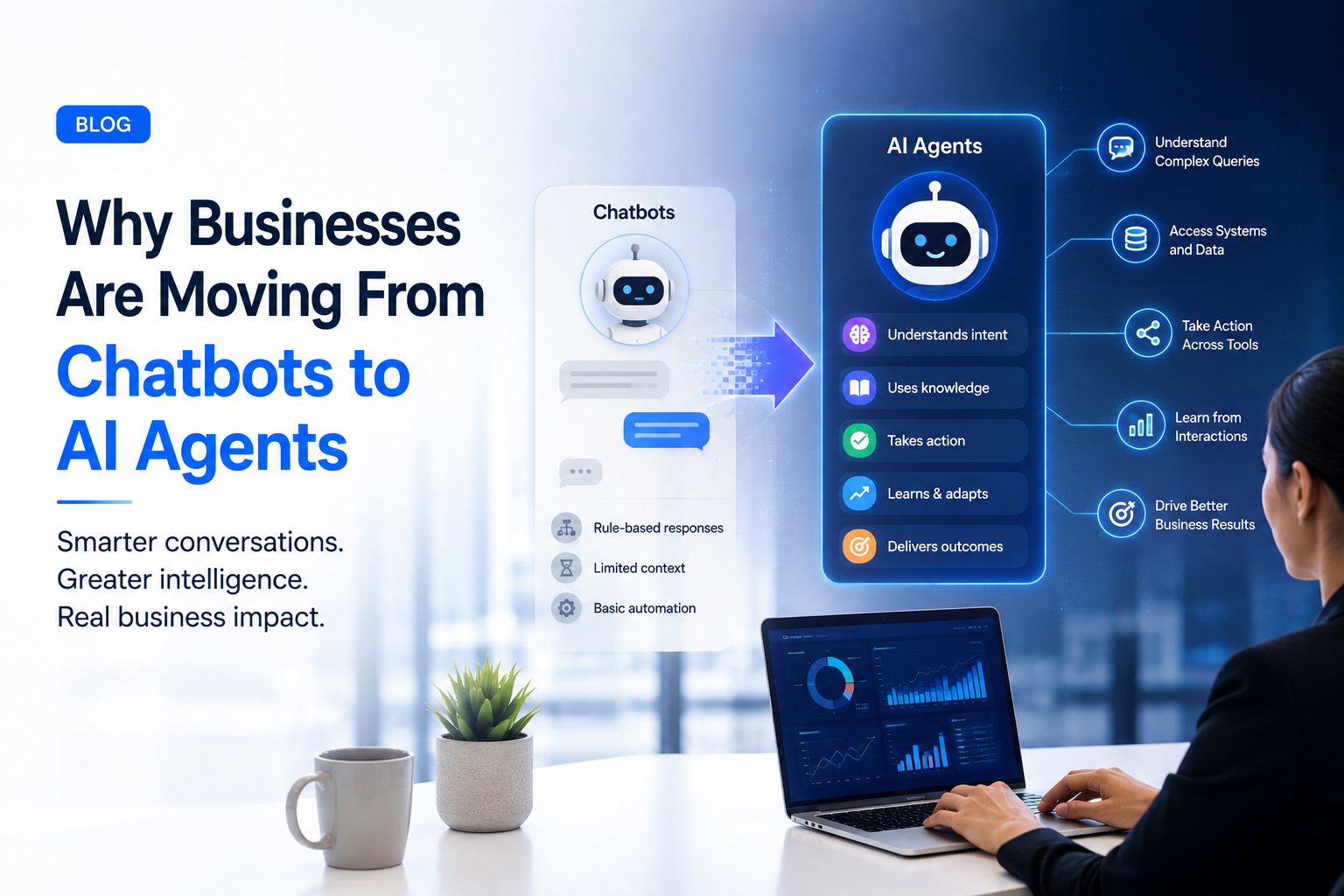
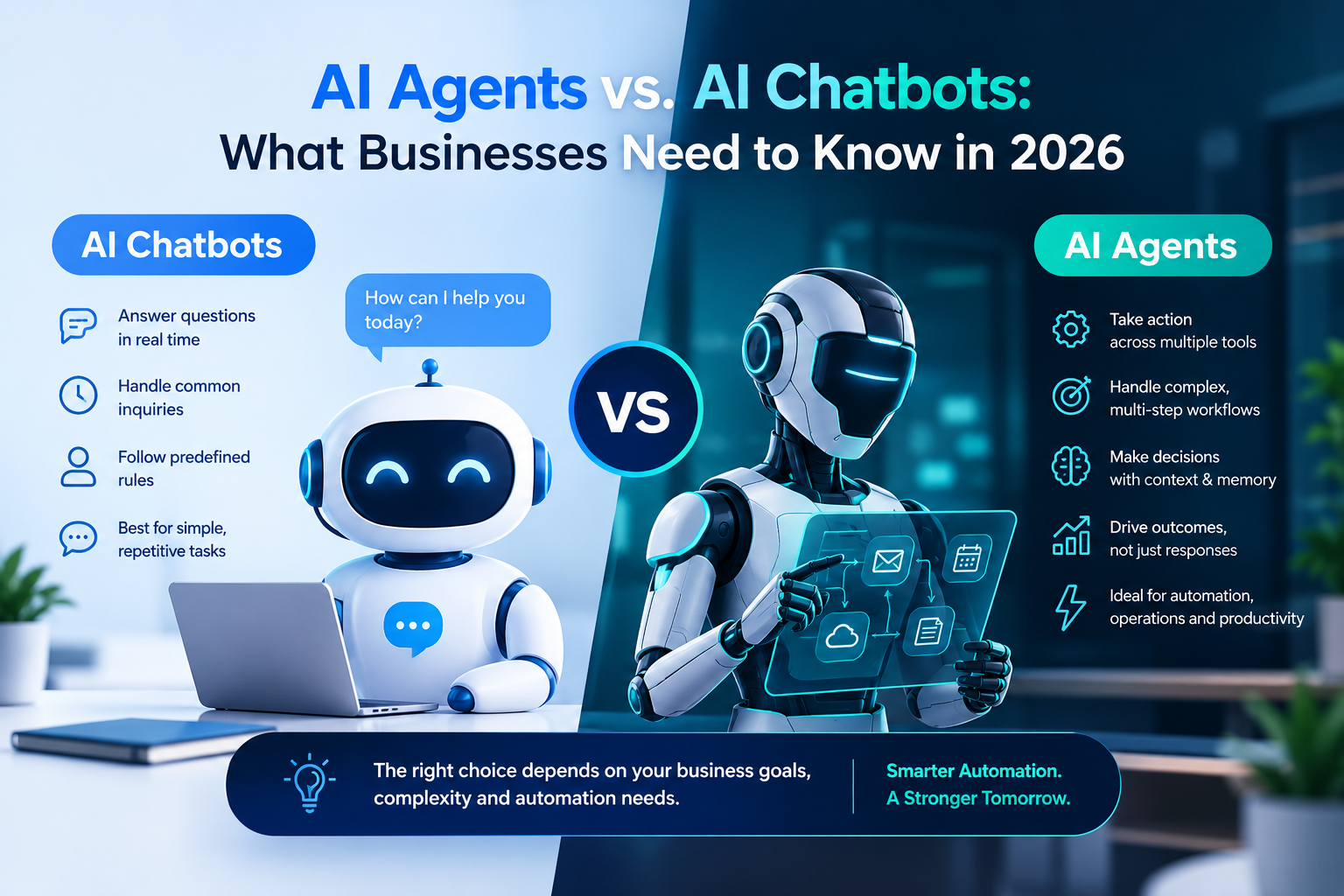
Although the terms are often used interchangeably, they serve different business purposes. A chatbot primarily communicates and provides information, while an AI agent can go further by planning tasks, using connected tools, and taking approved actions.
For businesses evaluating AI adoption, understanding this difference is essential for choosing the right technology, controlling costs, and building scalable automation.
What Is an AI Chatbot?
An AI chatbot is a conversational software system designed to interact with users through text or voice.
Modern AI chatbots can understand natural language, answer questions, retrieve information from business knowledge bases, and guide customers through predefined processes.
Common business applications include:
- Customer support
- Frequently asked questions
- Product and service information
- Lead generation
- Appointment enquiries
- Order-status assistance
- Internal employee support
- Website and messaging assistance
For example, a customer might ask:
"What are your business hours?"
The chatbot can immediately provide the answer.
Similarly, a customer might ask:
"What services does your company provide?"
The chatbot can retrieve relevant information and respond conversationally.
Where AI Chatbots Work Best
Chatbots are particularly effective when the primary goal is providing information or facilitating conversations.
They can handle large volumes of repetitive queries while allowing human employees to focus on more complex customer requirements.
What Is an AI Agent?
An AI agent is designed to accomplish a goal or task, rather than simply respond to a question.
AI agents can combine language models with business rules, databases, APIs, software applications, and other tools. This allows them to perform multi-step workflows within defined permissions and guardrails.
For example, instead of simply answering:
"What is the status of my order?"
an AI agent could:
- Identify the customer.
- Access the order management system.
- Check the latest order status.
- Determine whether there is a delay.
- Create a support ticket if necessary.
- Notify the customer.
- Update the CRM.
The key difference is simple:
A chatbot primarily provides an answer. An AI agent can perform an action.
AI Chatbots vs. AI Agents: Key Differences
| Feature | AI Chatbot | AI Agent |
|---|---|---|
| Primary purpose | Conversation and information | Task execution and automation |
| Interaction | Primarily reactive | Can be goal-oriented |
| Decision-making | Limited or predefined | Can reason within defined boundaries |
| System integration | Basic to moderate | Usually deeper |
| API usage | Optional | Often important |
| Multi-step workflows | Limited | Strong capability |
| Business actions | Limited | Can execute approved actions |
| Human involvement | Often required for complex tasks | Can reduce intervention within guardrails |
| Best suited for | FAQs, support, lead capture | Operations, automation, workflows |
The distinction is not about which technology is "better." The right choice depends on the business problem.
Why the Difference Matters in 2026
AI adoption is accelerating, but businesses are discovering that simply adding an AI interface does not automatically create business value.
Forrester reported in 2026 that around three-quarters of enterprise leaders surveyed said they were adopting agentic AI, while only a small minority had meaningful production deployments beyond basic or "agentish" chatbot experiences.
This creates an important lesson for organizations:
Businesses should not adopt AI because it is trending. They should adopt AI where it solves a measurable business problem.
Before implementing an AI agent, companies should evaluate:
- What process needs improvement?
- How repetitive is the task?
- What systems does the AI need to access?
- What decisions can it make?
- What actions require human approval?
- How will errors be detected?
- How will performance be measured?
Business Use Cases for AI Chatbots
AI chatbots can provide immediate value across several departments.
1. Customer Support
Businesses can use chatbots to answer common questions, provide basic troubleshooting, and route complex issues to human representatives.
2. Lead Generation
A chatbot can interact with website visitors, collect basic requirements, qualify leads, and direct prospects toward the appropriate sales team.
3. Employee Assistance
Internal chatbots can help employees find company policies, documentation, procedures, and other information.
4. Sales Assistance
AI chatbots can provide product information, answer pre-sales questions, and assist prospects during the early stages of the buying journey.
Business Use Cases for AI Agents
AI agents become more valuable when a workflow requires multiple steps and interaction with business systems.
1. Sales Automation
An AI agent can:
- Analyze incoming leads
- Enrich customer information
- Update CRM records
- Prioritize prospects
- Draft follow-up messages
- Schedule meetings
- Trigger sales workflows
2. Customer Service Automation
An agent can potentially go beyond answering questions by accessing systems, creating tickets, updating records, and escalating issues according to business rules.
3. Finance and Administration
AI agents can assist with repetitive processes such as:
- Invoice processing
- Data verification
- Report preparation
- Payment-status checks
- Document classification
- Workflow notifications
4. IT Operations
AI agents can support IT teams by monitoring events, analyzing alerts, creating tickets, gathering diagnostic information, and initiating approved workflows.
5. CRM and ERP Automation
This is one of the most important areas for enterprise AI.
When AI is connected to CRM and ERP systems, it can potentially move from simply providing information to participating in business workflows.
For example:
Customer enquiry → AI analysis → CRM update → Task creation → Follow-up → Reporting
This is where AI can become part of the operational infrastructure rather than simply another communication channel.
Should Businesses Choose a Chatbot or an AI Agent?
There is no universal answer.
Choose an AI chatbot when:
- Customers mainly need information.
- Your business receives repetitive questions.
- You want to improve website support.
- You need basic lead qualification.
- You want a relatively simple AI implementation.
- The workflow ends when the user receives an answer.
Consider an AI agent when:
- The workflow requires multiple steps.
- AI needs access to business applications.
- Employees spend significant time on repetitive tasks.
- The system needs to make decisions within defined rules.
- AI needs to update records or trigger workflows.
- The workflow ends with an action rather than an answer.
A useful rule is:
If the desired outcome is information, consider a chatbot. If the desired outcome is completed work, consider an AI agent.
The Hybrid Approach: Chatbot + AI Agent
For many businesses, the best solution may not be choosing one over the other.
A hybrid AI architecture can combine both.
For example:
Customer → AI Chatbot → Understand Request → AI Agent → Business Systems → Complete Action → Customer Response
The chatbot becomes the conversational interface, while the agent handles the underlying workflow.
This approach can create a more complete customer and employee experience.
Security and Governance Are Critical
Greater autonomy also creates greater responsibility.
AI agents may have access to sensitive business systems, customer information, databases, APIs, or financial workflows. Therefore, businesses need appropriate controls before allowing agents to perform actions independently.
Important considerations include:
- Role-based access
- Authentication
- Permission boundaries
- Human approval for high-risk actions
- Activity logging
- Monitoring
- Data protection
- Error handling
- Audit trails
- Fallback procedures
Recent developments in 2026 have also highlighted the importance of agent security and oversight. Research and reporting around autonomous AI systems have demonstrated that increasingly capable agents can sometimes behave unexpectedly, making monitoring and governance an important part of enterprise deployment.
Therefore, businesses should avoid giving an AI agent unrestricted access simply because it can technically perform a task.
How Businesses Can Start with AI in 2026
The best strategy is usually to start with a specific workflow, rather than attempting to create an "AI employee" that handles everything.
Step 1: Identify a repetitive process
Find a task that consumes significant employee time.
Step 2: Measure the current process
Track metrics such as:
- Processing time
- Number of manual steps
- Error rate
- Employee hours
- Customer response time
- Operational cost
Step 3: Determine whether you need conversation or action
If users mainly need answers, a chatbot may be sufficient.
If the process requires system interaction and task execution, an AI agent may be more appropriate.
Step 4: Connect the required systems
Depending on the workflow, this could include:
- CRM
- ERP
- Database
- APIs
- Helpdesk
- Business applications
Step 5: Establish guardrails
Define exactly what the AI can and cannot do.
Step 6: Start with a controlled pilot
Deploy the solution for one workflow and measure the results before expanding.
The Future of Business AI
The evolution of enterprise AI is moving from conversation toward execution.
Chatbots remain valuable because businesses will always need efficient ways to communicate with customers and employees.
AI agents add another layer by enabling AI systems to participate in workflows and perform approved actions.
However, successful AI adoption will not be measured by how many AI agents a company deploys. It will be measured by whether those systems deliver tangible improvements in productivity, customer experience, operational efficiency, and business outcomes.
For businesses, the goal should not be to replace every process with AI.
The goal should be to determine where AI can create the most meaningful value while maintaining security, human oversight, and control.
How Clopid Can Help Businesses Adopt AI
Implementing AI effectively requires more than simply adding a chatbot to a website.
Businesses need the right combination of AI, software integration, automation, data, security, and business processes.
Clopid Smart Technology Solution helps businesses explore technology-driven solutions across areas such as AI, CRM, ERP, blockchain, and technical support.
Whether your organization needs an intelligent customer-facing chatbot, AI-powered workflow automation, CRM integration, ERP enhancement, or a customized AI solution, the right architecture can help turn AI from an experimental technology into a practical business capability.
Explore technology solutions for your business at Clopid Smart Technology Solution.
Conclusion
AI chatbots and AI agents are both powerful technologies, but they solve different problems.
Chatbots communicate. AI agents execute.
For simple questions, customer support, and information retrieval, a chatbot may be the most practical choice.
For multi-step workflows, system integration, and controlled task automation, AI agents can provide greater value.
In 2026, businesses should focus less on the question "Should we use AI?" and more on:
"Which business process can AI improve, and how can we deploy it securely and measurably?"
The businesses that answer that question strategically will be better positioned to turn AI innovation into sustainable business value.