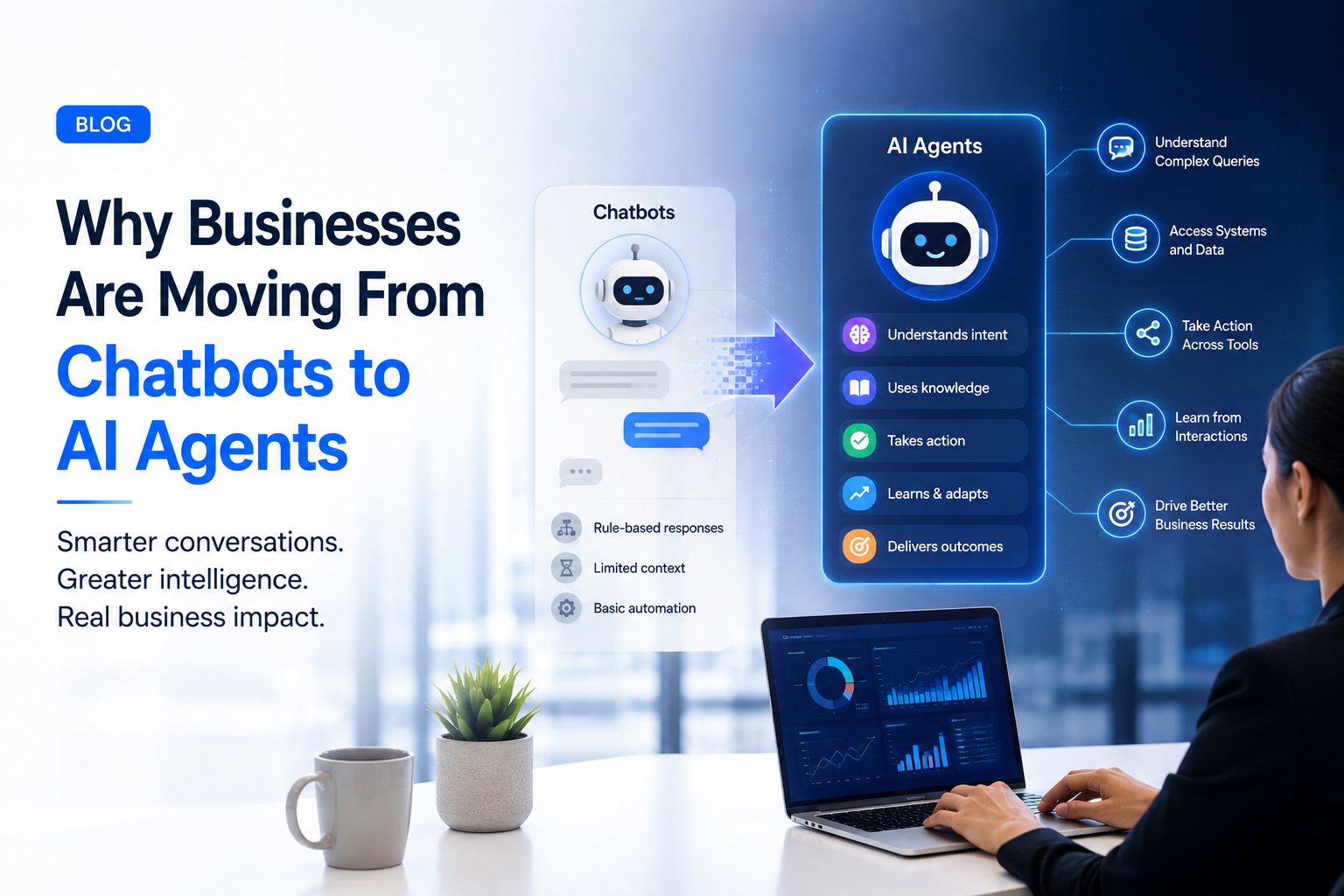
Why Businesses Are Moving From Chatbots to AI Agents
For years, chatbots have been one of the most visible applications of artificial intelligence in customer service. They helped businesses automate frequently asked questions, provide basic support, and remain available around the clock.
But customer expectations and business requirements are becoming more sophisticated.
Customers want faster and more personalized assistance, while businesses want technology that can do more than simply answer questions.
This shift is driving growing interest in AI agents — intelligent systems capable of understanding objectives, making decisions, using business tools, and completing tasks with greater levels of autonomy.
The transition from traditional chatbots to AI agents represents a broader evolution from conversation-based automation to intelligent task execution.
Chatbots vs. AI Agents: What's the Difference?
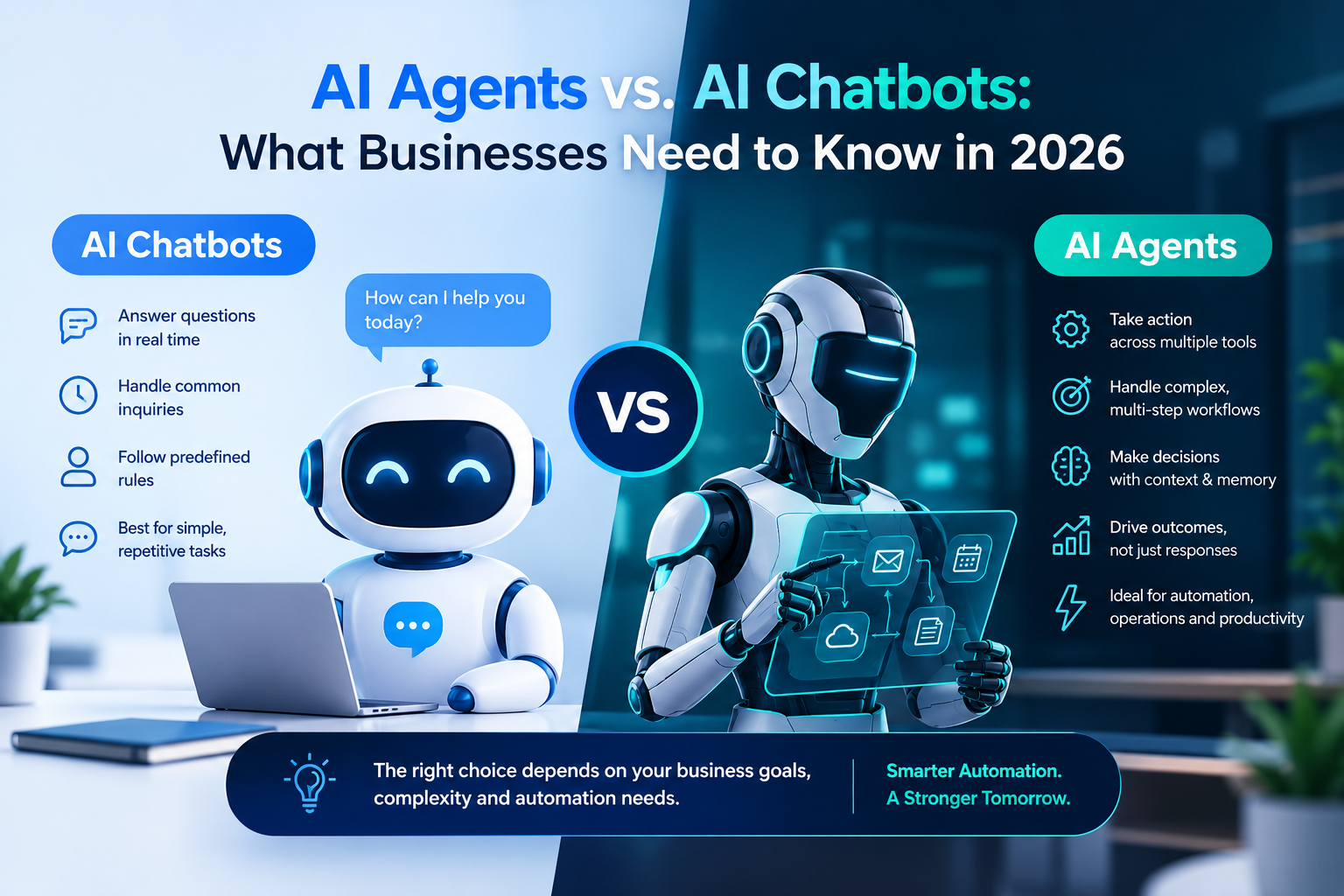
A traditional chatbot is generally designed to respond to customer inputs based on predefined workflows, rules, or knowledge sources.
AI agents go a step further.
An AI agent can interpret a goal, reason through available information, determine appropriate actions, use connected tools, and work through multiple steps to accomplish a task.
For example, a chatbot might answer:
"What is the status of my order?"
An AI agent could potentially:
Identify the customer → Access the order system → Check the latest status → Detect a delivery issue → Create a support ticket → Notify the customer
This difference is at the heart of the shift toward agentic AI.
Why Businesses Are Moving Beyond Traditional Chatbots
1. Customers Expect More Than Simple Answers
Modern customers often have complex requirements that cannot be solved through predefined responses.
They may need help with billing, technical issues, account changes, product recommendations, or multiple connected requests.
AI agents can help manage more complex workflows by combining natural-language understanding with access to relevant business systems.
2. AI Agents Can Take Action
One of the biggest differences between chatbots and AI agents is action.
Traditional chatbots primarily provide information.
AI agents can be designed to perform actions through connected systems.
Depending on the implementation, an AI agent could:
- Create or update support tickets
- Retrieve customer information
- Schedule appointments
- Process routine requests
- Update CRM records
- Check inventory
- Generate reports
- Escalate complex cases
- Trigger business workflows
This turns AI from a communication tool into a potential business process automation layer.
3. Greater Contextual Understanding
Modern AI agents can combine information from multiple approved data sources to understand the context behind a request.
For example, instead of looking only at a customer's current message, an AI system could potentially consider:
Customer Profile + Previous Interactions + Current Request + Transaction Data + Business Policies
This broader context can support more relevant responses and decisions.
4. Reduced Repetitive Work
Businesses spend significant resources on repetitive operational tasks.
AI agents can help automate multi-step workflows that previously required employees to move between different systems.
This allows employees to focus more on activities that require creativity, judgment, relationship management, and specialized expertise.
5. 24/7 Digital Operations
Unlike human teams, AI systems can operate continuously.
AI agents can support customers and execute eligible workflows outside traditional business hours, helping organizations provide more consistent digital service across different time zones.
AI Agents and Enterprise Systems
The real potential of AI agents becomes clearer when they are connected to enterprise applications.
An AI agent can potentially work with systems such as:
- CRM platforms
- ERP systems
- Help desk software
- Knowledge management platforms
- E-commerce systems
- Inventory databases
- Analytics platforms
- Communication tools
For example:
Customer Request → AI Agent → CRM → Business Rules → Enterprise System → Action → Customer Update
This type of integration allows AI to become part of an organization's broader digital workflow rather than operating as an isolated chatbot.
From Reactive Support to Proactive Service
Traditional chatbots are primarily reactive. A customer asks a question, and the chatbot responds.
AI agents open the possibility of more proactive service.
For example, an AI system could identify a potential issue from available business data and recommend or initiate an appropriate workflow before the customer contacts support.
This can help businesses move from:
"How can we answer customers faster?"
to:
"How can we identify and resolve customer needs earlier?"
That is a significant shift in customer experience strategy.
AI Agents Can Also Support Employees
The move toward AI agents is not limited to customer-facing applications.
Businesses can deploy intelligent agents to support internal teams as well.
Examples include:
Sales
AI agents can help qualify leads, summarize customer interactions, and update CRM information.
Marketing
AI systems can assist with research, content workflows, campaign analysis, and reporting.
IT Support
Agents can help diagnose common issues, retrieve documentation, and initiate approved support workflows.
Operations
AI agents can assist with repetitive data processing, reporting, and workflow coordination.
Customer Service
Agents can analyze requests, retrieve information, recommend solutions, and execute approved actions.
This makes AI agents relevant across multiple business functions.
Challenges Businesses Need to Consider
Despite their potential, AI agents should not be deployed without proper planning.
Data Security
AI agents may interact with sensitive business and customer information. Organizations need appropriate security controls, permissions, and data governance.
Human Oversight
Not every decision should be fully autonomous.
Businesses should determine which actions can be automated and which require human approval.
Integration Complexity
AI agents need access to reliable information and connected systems to perform meaningful tasks. Poor integrations can reduce their effectiveness.
Accuracy and Reliability
AI-generated decisions and actions should operate within clearly defined business rules, with monitoring and escalation mechanisms where appropriate.
Responsible AI
Organizations should consider transparency, privacy, accountability, and appropriate access controls when implementing agentic AI.
The Future: From AI Assistants to Autonomous Business Systems
The evolution from chatbots to AI agents is part of a much larger transformation in enterprise technology.
The future is likely to involve multiple specialized AI agents working together across business functions.
For example:
Customer Agent → CRM Agent → Billing Agent → Inventory Agent → Human Approval
Each agent could perform a specific role while coordinating through a larger workflow.
This could help organizations build more intelligent and automated digital operations without removing human oversight from important decisions.
Conclusion
Businesses are moving from chatbots to AI agents because they need more than automated conversations.
Traditional chatbots remain useful for FAQs and straightforward customer interactions, but AI agents can potentially understand broader context, interact with business systems, make recommendations, and execute multi-step workflows.
The key difference is simple:
Chatbots primarily answer. AI agents can understand, decide, and act.
As businesses continue investing in AI, automation, CRM, ERP, and intelligent digital solutions, AI agents are becoming an important part of the next generation of enterprise technology.
Organizations that approach this transition strategically can use AI not just to improve customer conversations, but to create smarter and more efficient business processes.
Clopid helps businesses explore smart technology solutions across AI, CRM, ERP, blockchain, and IT services — enabling organizations to build more connected, efficient, and future-ready digital operations.
Explore more solutions at Clopid.