What Is Blockchain Technology?
Blockchain is a digital way to store and share records. It keeps information in blocks that are linked together. Copies of the ledger are shared across multiple computers, known as nodes.
Each block contains data and a cryptographic link to the block before it. This design helps protect records and makes unauthorized changes easier to detect.
The National Institute of Standards and Technology (NIST) describes blockchain as a tamper-evident and tamper-resistant distributed digital ledger. In simple terms, the system is designed to make hidden changes difficult.
Read the NIST Blockchain Technology Overview for a detailed technical explanation.
Businesses can use blockchain to:
- Track products and deliveries.
- Record financial transactions.
- Verify digital documents.
- Manage digital assets.
- Run smart contracts.
- Share records with business partners.
However, blockchain is not necessary for every business. A traditional database may be a better choice when one organization manages all the records.
What Is a Public Blockchain?
A public blockchain is an open network. Anyone can access it and participate under its rules.
Users do not need approval from one company to join. Instead, the network follows shared rules to check and record transactions.
How Does a Public Blockchain Work?
A public blockchain follows five basic steps:
- A user submits a transaction.
- Network computers receive and check it.
- Validators or miners verify the transaction.
- Valid transactions are added to a block.
- The updated ledger is shared across the network.
The exact process depends on the blockchain.
For example, Bitcoin uses proof of work, while Ethereum uses proof of stake. Both methods help their networks agree on valid transactions.
According to Ethereum's network documentation, public networks allow users to read data, submit transactions, and participate in validation under the network rules.
What Are Examples of Public Blockchains?
Bitcoin
Bitcoin is a public blockchain designed for peer-to-peer digital payments. It uses proof of work to validate transactions.
Ethereum
Ethereum supports smart contracts and decentralised applications. Developers use it to build digital services that run on the network.
Solana
Solana is a public blockchain designed to support digital applications and transactions.
These networks have different technical designs. Their transaction fees, speed, and validation methods can vary.
What Are the Benefits of Public Blockchains?
Public blockchains offer several benefits:
- Open access: Anyone can join under the network rules.
- Transparency: People can view public transactions.
- Shared participation: No single company controls the entire network.
- Global access: Users can connect from different locations.
- Independent verification: Participants can check recorded transactions.
These features make public blockchains useful for open digital services.
What Are the Limitations of Public Blockchains?
Public networks also have some challenges:
- Privacy: Transaction details may be visible to the public.
- Changing fees: Costs can rise when network activity increases.
- Performance: Speed depends on network design and demand.
- Governance: Protocol changes may require agreement among many participants.
- Compliance: Public records can create privacy and regulatory concerns.
A public blockchain may not suit a business that needs strict control over confidential information.
What Is a Private Blockchain?
A private blockchain is a restricted digital network. Only approved users can join or perform specific activities.
An organisation or group of organisations manages access. It decides who can view records, submit transactions, and approve information.
Businesses often consider private blockchains when they need to share records with trusted partners.
How Does a Private Blockchain Work?
A private blockchain uses controlled access:
- An administrator approves network members.
- Each member receives a digital identity.
- Users get permissions based on their roles.
- Selected network nodes validate transactions.
- Approved records are added to the shared ledger.
- Members can view information allowed by their permissions.
Consider a manufacturer working with suppliers and delivery companies. A private blockchain could help these partners share product records while keeping confidential prices and agreements restricted.
What Are Examples of Private Blockchain Platforms?
Hyperledger Fabric: An open-source framework for permissioned business networks. It supports user identities, access rules, channels, and private data collections.
R3 Corda: A distributed ledger platform designed for business networks, including financial services and regulated workflows.
Hyperledger Besu: An Ethereum client that can run in public and private network environments.
The Hyperledger Fabric documentation explains how organisations and permissions work within a private blockchain network.
What Are the Benefits of Private Blockchains?
Private blockchains give businesses greater control over network access.
- Restricted access: Only approved users can join.
- Data control: Permissions limit who can view specific records.
- Clear responsibilities: Organisations can define roles and rules.
- Business integration: Networks can connect with existing systems.
- Known participants: Businesses can identify the organisations using the network.
These features can help companies manage shared records.
What Are the Limitations of Private Blockchains?
Private networks also have costs and risks:
- Limited participation: New users need approval.
- Setup costs: Development, hosting, and integration require investment.
- Trust requirements: Members must trust the organisations managing the network.
- Governance issues: Participants must agree on rules and responsibilities.
- Security risks: Weak access controls can expose business information.
A private blockchain is not automatically more secure than a public one. Its safety depends on how well it is designed and managed.
Private vs. Public Blockchain: What Are the Key Differences?
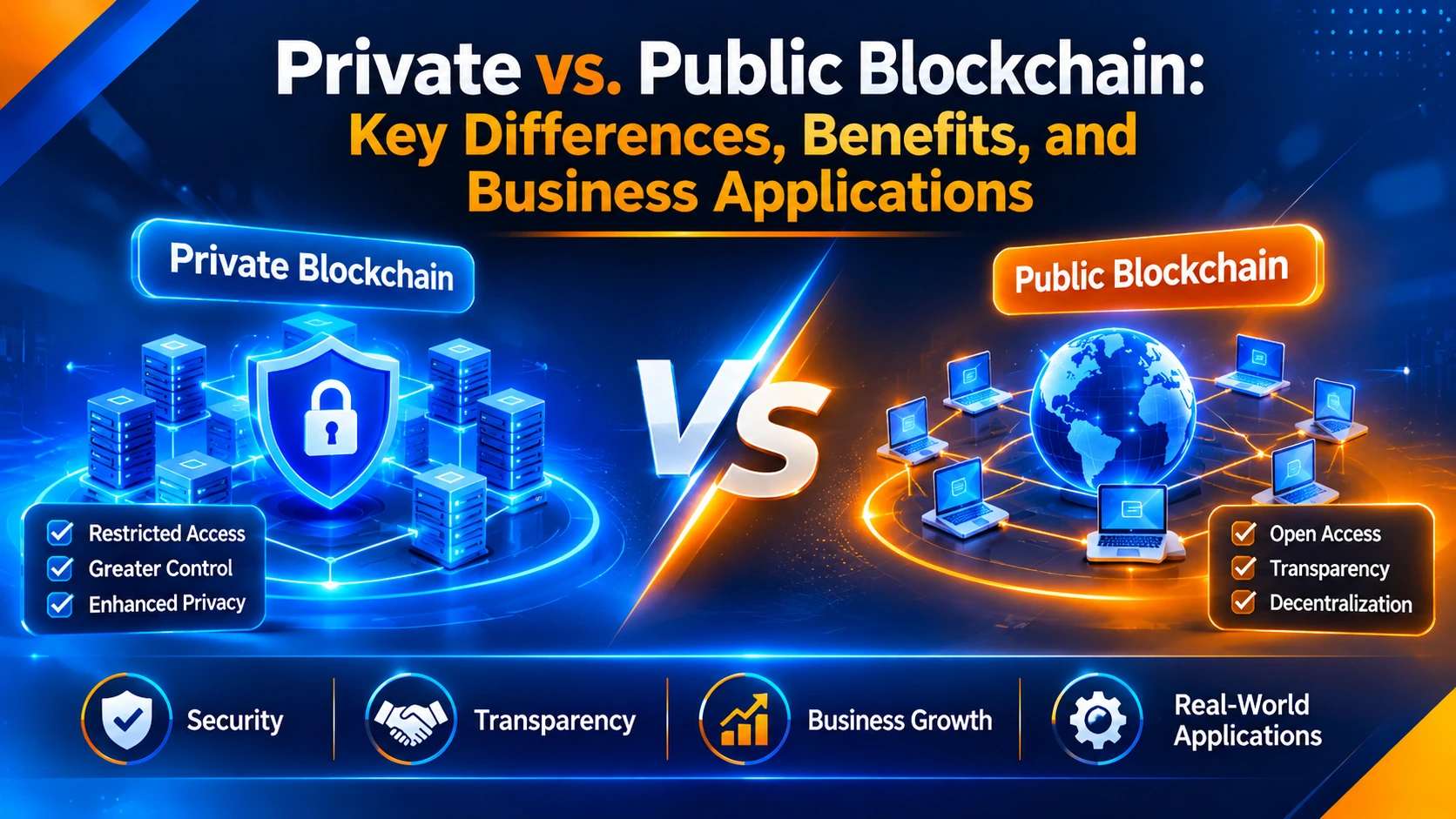
The biggest difference is access. Public blockchains are open to participants, while private blockchains allow only approved users.
Here is a direct comparison:
| Feature | Public Blockchain | Private Blockchain |
|---|---|---|
| Access | Open to anyone | Approved users only |
| Participation | Generally open | Permission-based |
| Governance | Shared across network participants | Managed by an organisation or group |
| Privacy | Transactions are usually public | Access can be restricted |
| Validation | Follows public network rules | Uses selected authorised participants |
| Identity | Often pseudonymous | Usually based on verified identities |
| Performance | Depends on network demand and design | Can be configured for known participants |
| Costs | Fees may change with network demand | Depends on infrastructure and maintenance |
| Common uses | Digital assets and decentralised apps | Enterprise records and business workflows |
These are general differences. Individual blockchain platforms may use different designs.
Which Blockchain Is More Secure?
Neither model is automatically more secure. Security depends on the technology, network design, and management.
Public blockchains may benefit from many independent participants. Their open records also allow people to check transactions.
Private blockchains give businesses more control over users and permissions. However, they may depend on a small group of administrators.
Before choosing a blockchain, businesses should check six areas:
- User identity: How does the system verify users?
- Access control: Can users view only the information they need?
- Transaction approval: Who can validate transactions?
- Smart contracts: Has the code been tested for security issues?
- Monitoring: Can the business detect unusual activity?
- Recovery: Is there a plan for outages or data loss?
Good security requires regular checks and maintenance. Choosing a blockchain model is only the first step.
What Is a Hybrid Blockchain?
A hybrid blockchain combines features of public and private networks.
It allows businesses to keep some information private while making selected records available for public verification.
For example, a company may store confidential transaction details in a private system. It can publish a cryptographic hash on a public blockchain.
A hash is a digital value created from data. It can help verify whether a record has changed. It does not reveal the original confidential information by itself.
Where Can Businesses Use Hybrid Blockchains?
Supply chains: Companies can keep supplier prices private while allowing customers to verify selected product details.
Healthcare: Providers can restrict patient records while supporting document verification.
Education: Institutions can protect student details while allowing employers to check certificates.
Financial services: Organisations can keep sensitive transaction details private while sharing selected verification records.
Hybrid systems offer flexibility, but they also need careful planning, integration, and data protection.
Which Blockchain Model Should a Business Choose?
The right model depends on the business goal and the people who need access.
| Business Need | Possible Choice | Why? |
|---|---|---|
| Open participation | Public | Anyone can join under network rules |
| Public transaction verification | Public | Records can be checked independently |
| Confidential business records | Private | Access is restricted |
| Collaboration between known companies | Private | Partners share a controlled ledger |
| Private data with public verification | Hybrid | Different records have different access levels |
| Decentralised applications | Public | Supports open participation |
| Controlled enterprise workflows | Private | Supports defined roles and permissions |
Use this table as a starting point. A final decision should also consider cost, performance, security, and legal requirements.
What Are the Business Applications of Blockchain?
Public and private blockchains can support different business activities. The right option depends on the information being shared and the level of control required.
1. Supply Chain Management
Supply chains involve manufacturers, suppliers, distributors, and delivery companies.
A private blockchain can help these partners share product records, delivery updates, and approvals.
A hybrid system may also let customers verify selected product information.
2. Financial Services
Financial organisations manage payments, assets, and transaction records.
Public blockchains support open digital asset networks. Private networks may suit financial institutions that need controlled access and clear business rules.
3. Healthcare
Healthcare providers manage sensitive patient information.
A permissioned blockchain may help authorised organisations verify records and maintain audit trails.
Patient data needs strong protection. Businesses should review privacy and legal requirements before storing personal information on a blockchain.
4. Digital Identity
Blockchain can support digital identity and credential verification.
For example, an institution can issue a digital certificate. Another organisation can then check whether the certificate is genuine.
The system should share only the information needed for verification.
5. Real Estate
Property transactions involve buyers, sellers, banks, legal professionals, and government records.
A permissioned blockchain may help these parties maintain shared transaction records and verify documents.
However, blockchain records do not automatically replace legal ownership documents or official land registration.
6. Education and Digital Certificates
Educational institutions can issue digital certificates to students.
Employers and other institutions can verify these certificates when needed.
A blockchain-based system can help identify unauthorised changes. Personal details can remain outside the blockchain, with only a verification reference stored on the network.
How Should a Business Evaluate a Blockchain Project?
Choosing a blockchain should start with the business problem, not the technology.
These seven steps can help organisations plan a project.
1. Define the Business Problem
First, identify what needs to improve.
Does the business need to share records, verify transactions, reduce manual work, or track products?
If a normal database can solve the problem, blockchain may not be necessary.
2. Identify the Participants
List every organisation and user that needs access.
If anyone should be able to participate, a public network may be suitable. If the users are known, a private network may be a better option.
3. Review Privacy Requirements
Decide which information is confidential and who can view it.
The European Data Protection Board's blockchain guidelines explain important data protection issues. These include data minimisation, storage limits, and individuals' rights.
Businesses should review these requirements before storing personal data on a blockchain.
4. Check Performance Needs
Estimate the number of transactions and users.
Also consider how quickly the system must respond.
Test the proposed network under realistic conditions. Do not assume a private blockchain will always be faster.
5. Calculate the Total Cost
The initial development cost is only one part of the budget.
Businesses should also consider:
- Infrastructure and hosting
- Development and integration
- Identity management
- Security testing
- Monitoring and maintenance
- Transaction fees, where applicable
- Upgrades and technical support
6. Set Governance Rules
Decide who can approve users and change network rules.
Also define who will manage disputes and technical updates.
This is especially important when several organisations share the same network.
7. Test Before Launch
Start with a small proof of concept.
Check security, performance, integrations, user permissions, and recovery procedures before expanding the project.
Practical Example: Choosing a Blockchain for a Supply Chain
Consider a manufacturer that works with several suppliers and delivery partners.
The company wants all partners to view product movement records. However, supplier prices and business agreements must remain private.
A public blockchain may expose more information than the partners want to share.
A private blockchain could give approved partners access to shared records. A hybrid model could also publish selected verification details for customers.
This scenario shows how business requirements can guide the choice of blockchain. It is an example of a possible application, not a claim about a specific client deployment.
Is Blockchain Better Than a Traditional Database?
No. Blockchain is not always the better option.
A traditional database is often suitable when one company controls the information and manages user access.
Blockchain may be more useful when several independent organisations need to share and verify records.
| Requirement | Traditional Database | Blockchain |
|---|---|---|
| One organisation manages records | Often suitable | May be unnecessary |
| Multiple parties share records | Needs controlled coordination | Can provide a shared ledger |
| Frequent editing or deletion | Usually easier | Can be more complex |
| Independent verification | Depends on access and controls | Supported by network rules |
| Access management | Often centrally managed | Depends on network design |
| Shared audit trail | Can be implemented | Part of the ledger design |
The best choice is the one that solves the business problem without adding unnecessary cost or complexity.
Frequently Asked Questions
What Is the Main Difference Between Public and Private Blockchain?
A public blockchain is open to participants. A private blockchain allows only approved users. The main differences are access, privacy, governance, and transaction approval.
Is a Public Blockchain Completely Transparent?
Public blockchain transactions are generally visible to anyone. However, wallet addresses do not always reveal a person's real identity. Not all information is stored on the blockchain.
Is a Private Blockchain Centralised?
A private blockchain uses controlled access. An organisation or group manages membership and governance. The level of centralisation depends on how responsibilities are shared.
Which Blockchain Is Better for Businesses?
A private blockchain may suit businesses that need controlled access and collaboration between known organisations. A public blockchain may suit open applications and public verification. The right choice depends on the project.
Can a Private Blockchain Be Hacked?
Yes. Private blockchains can face compromised accounts, insecure infrastructure, weak access controls, and smart contract vulnerabilities. Restricted access does not remove security risks.
Is a Private Blockchain Faster Than a Public Blockchain?
It can be faster in some situations because it has a defined group of participants. Actual performance depends on network design, infrastructure, transaction volume, and validation methods.
What Is a Permissioned Blockchain?
A permissioned blockchain requires approval for participation or specific activities. Private blockchains generally use permissioned access.
What Is a Permissionless Blockchain?
A permissionless blockchain allows users to join and interact without approval from a central administrator, subject to the network's rules.
Can Public and Private Blockchains Work Together?
Yes. Hybrid systems can connect private business networks with public blockchains. Businesses can keep confidential records private while publishing selected verification data.
Does Every Business Need Blockchain?
No. Blockchain is useful for certain shared-record and verification needs. A traditional database may be simpler and more cost-effective for many businesses.
Conclusion
Public and private blockchains serve different purposes.
Public networks support open participation and transparent records. Private networks give businesses more control over users, permissions, and shared information. Hybrid models combine selected features of both.
Before choosing a platform, businesses should review their goals, privacy needs, participants, costs, and security requirements.
The best blockchain solution is not always the most advanced one. It is the one that solves a real business problem without adding unnecessary complexity.
Explore Blockchain Solutions with CLOPID
A successful blockchain project needs more than a platform choice. It also needs suitable architecture, secure development, system integration, and ongoing support.
CLOPID offers Blockchain Solutions covering blockchain architecture, smart contracts, decentralised applications, and related technical services.
If your organisation is planning a blockchain project, discuss your requirements with the CLOPID team.
Contact CLOPID to explore a suitable solution.