Introduction
Businesses need safe ways to store, share, and verify information. Blockchain offers one way to do this. It creates a shared digital record that is difficult to change without detection.
Companies are exploring blockchain for payments, supply chains, digital identity, and digital assets. They can also use smart contracts to automate selected business tasks.
But blockchain is not the answer to every business problem. A traditional database may be simpler and cheaper for some projects.
Blockchain application development means building software that uses a blockchain network to store records, verify transactions, or run digital agreements.
This guide explains blockchain in simple terms. You will learn how it works, which platforms businesses use, where it adds value, and what to check before starting a project.
What Is Blockchain Technology?
Blockchain is a shared digital ledger. It stores records in groups called blocks. Each block links to the previous one through cryptography.
The National Institute of Standards and Technology (NIST) describes blockchain as a distributed ledger that is tamper-evident and tamper-resistant.
In simple terms, several computers can keep copies of the same record. They follow agreed rules to check new transactions.
For example, a manufacturer may share product records with suppliers and delivery partners. Each approved member can check the recorded history.
Key fact: Blockchain can help protect stored records from hidden changes. It cannot prove that the original information was true.
How Does Blockchain Work?
A blockchain network uses computers called nodes. These nodes share records and follow rules to approve new transactions.
Here is how a basic transaction works:
- A user sends a request. This could be a payment or a record update.
- The network checks it. The system checks the request against its rules.
- The network approves it. The network uses a consensus method to agree on valid updates.
- The record is added. The approved transaction becomes part of the ledger.
- The ledger is shared. Network participants receive the updated record.
Each block contains data and a cryptographic link to an earlier block. If someone changes an old record, that link changes too. This makes the change easier to detect.
NIST explains this process in its report, Blockchain Technology Overview (NISTIR 8202).
Main Parts of Blockchain Architecture
Blockchain architecture is the way a blockchain system is designed. It includes the network, data, rules, applications, and security controls.
Most solutions have five main parts.
1. Network Layer
This layer connects the computers that take part in the blockchain. These computers send and receive information.
2. Data Layer
This layer manages transactions, blocks, timestamps, and cryptographic links. It stores the history of network activity.
3. Consensus Layer
Consensus helps network participants agree on valid transactions.
Common methods include:
- Proof of Work (PoW): Uses computing work to help secure the network.
- Proof of Stake (PoS): Uses staked assets and validator rules.
- Practical Byzantine Fault Tolerance (PBFT): Helps known network members agree on updates.
Each method has different needs for speed, cost, energy, and security.
4. Smart Contract Layer
This layer contains programs that run business rules. A smart contract can perform an action when its conditions are met.
5. Application Layer
This is the part users see. It may include a website, mobile app, dashboard, or business portal.
APIs connect the application to blockchain services.
What Are Smart Contracts?
A smart contract is a program stored on a blockchain. It runs coded actions when set conditions are met.
For example, a company may want to release a payment after a delivery is approved. A smart contract can check the required digital approval and start the payment process.
Smart contracts can support:
- Digital payments
- Token transfers
- Business agreements
- Supply chain updates
- Access rules
- Decentralized applications
Ethereum supports smart contracts through its Ethereum Virtual Machine (EVM). Developers commonly write Ethereum contracts using Solidity or Vyper.
Important: Smart contracts cannot directly read every real-world event. They may need an external data service called an oracle.
For example, an insurance application may need verified weather data before it can process a claim. An oracle sends that data to the smart contract.
Ethereum's official documentation explains this limitation in its Oracle guide.
Types of Blockchain Networks
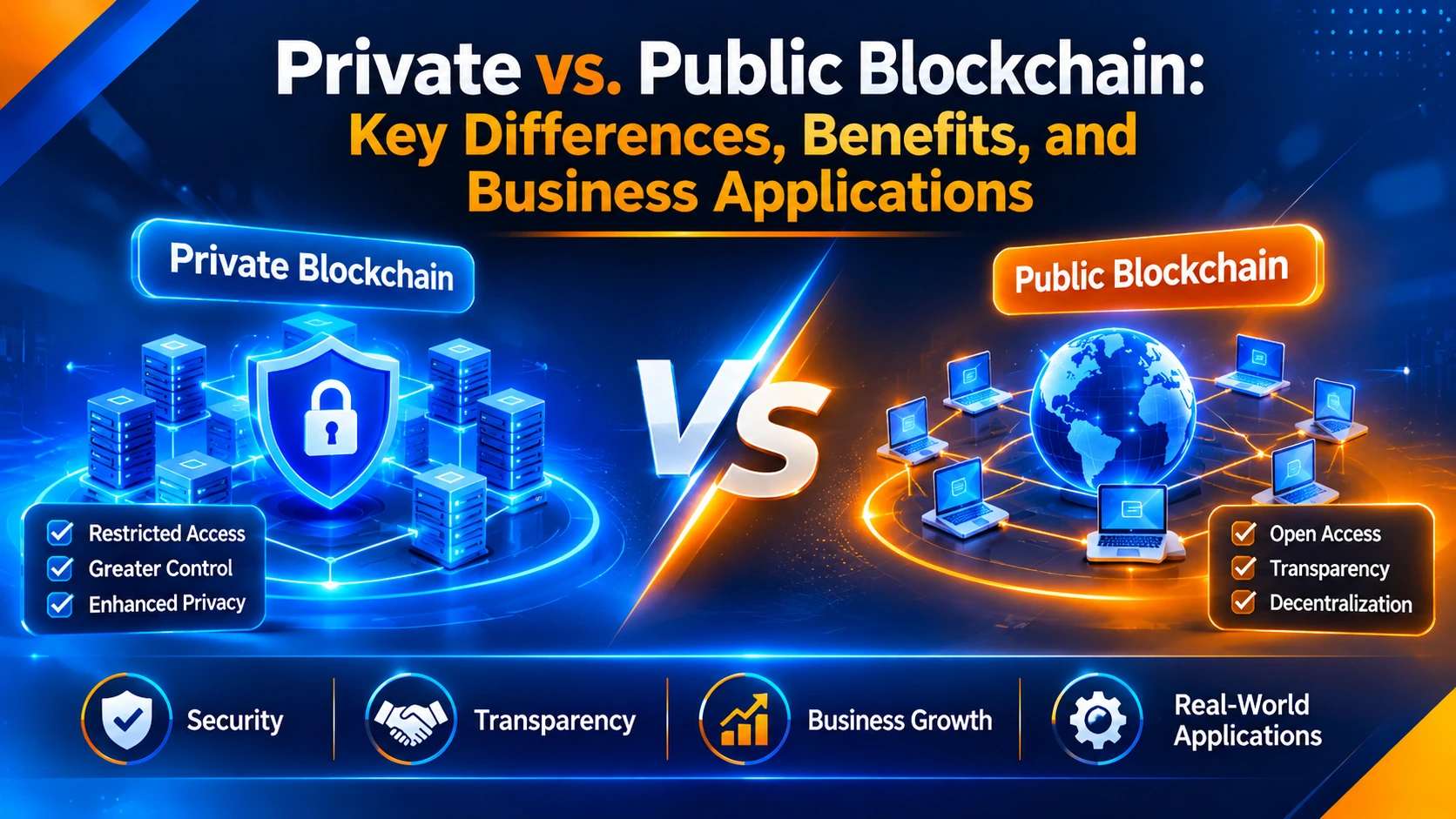
Businesses can choose from four common network types. The main difference is who can join and who controls access.
Public Blockchain
A public blockchain is open to users who follow its network rules.
Examples: Ethereum and Solana.
Common uses: Digital assets, public applications, and open financial services.
Private Blockchain
A private blockchain allows only approved users to join. One organization or a selected group manages access.
Common uses: Internal business records and controlled workflows.
Consortium Blockchain
A consortium blockchain is managed by several organizations. Approved members share responsibility for the network.
Common uses: Banking, trade, logistics, and shared industry records.
Hybrid Blockchain
A hybrid blockchain combines public and private features. Some records can stay restricted while selected information is shared more widely.
Common uses: Business systems that need both privacy and public verification.
Popular Blockchain Development Platforms
The right platform depends on the project. Businesses should compare cost, speed, privacy, tools, security, and long-term support.
| Platform | Main feature | Common use |
| Ethereum | Smart contracts and EVM support | Decentralized applications |
| Hyperledger Fabric | Permissioned network and identity controls | Enterprise blockchain |
| Polygon | Ethereum-related scaling tools | Scalable blockchain applications |
| Solana | Accounts, programs, and transactions | High-performance applications |
Ethereum
Ethereum is a blockchain platform for smart contracts and decentralized applications.
Its developer documentation covers accounts, transactions, smart contracts, and the EVM.
Hyperledger Fabric
Hyperledger Fabric is designed for permissioned business networks. It allows approved organisations and users to take part.
Fabric uses a Membership Service Provider (MSP) to help check participant identities and permissions.
This makes it useful for business networks where access must be controlled.
Polygon
Polygon provides blockchain infrastructure linked to the Ethereum ecosystem. Developers can review its network and tools when planning an Ethereum-related application.
Solana
Solana uses accounts and programs to manage data and application logic.
Its documentation explains how instructions call programs and how transactions group those instructions.
You can explore the official Solana developer documentation.
Benefits of Blockchain for Businesses
Blockchain can help businesses that need a shared record across different teams or organisations.
1. Shared Records
Approved participants can use the same ledger. This can reduce differences between separate records.
2. Better Tracking
Companies can record product movement, payments, and changes in ownership. This helps users review the history of an item or transaction.
3. Record Protection
Cryptographic links help reveal changes to earlier records. This supports data integrity.
4. Automated Tasks
Smart contracts can run selected business rules. This may reduce manual work in suitable processes.
5. Controlled Access
Permissioned networks can set rules for who can view, submit, or approve records.
6. Digital Assets
Blockchain can support digital tokens that represent certain assets or rights. Their use must follow relevant legal and business rules.
Remember: These benefits are not automatic. Results depend on system design, data quality, user adoption, cost, and security.
Business Uses of Blockchain
Blockchain can support many industries. It is most useful when different parties need to share and verify records.
Banking and Finance
Financial organizations can explore blockchain for payments, digital assets, and transaction records.
A shared ledger may help different parties work with consistent information. Financial projects must also meet security and regulatory rules.
Supply Chain Management
Manufacturers, suppliers, warehouses, and retailers can record product events on a shared network.
For example, a company can record when goods leave a factory, reach a warehouse, and arrive at a store.
This can improve product tracking. The system still needs reliable data from people and devices.
Healthcare
Healthcare organizations can explore blockchain for consent records, document checks, and data access logs.
Patient information needs strong privacy controls. Sensitive medical records should not be exposed to unauthorized users.
Real Estate
Blockchain can support digital records for selected property documents and transactions.
It does not replace official registration, legal checks, or local property laws.
Digital Identity
Blockchain can support systems that issue or verify digital credentials.
A good design should protect personal data and give users control over how their information is shared.
Insurance
Insurers can use smart contracts for selected claim steps.
For example, a contract may use verified weather data to check whether a policy condition has occurred. The data source must be reliable.
Blockchain Application Development Process
A successful project starts with a clear business need. The technology should solve a real problem.
Here are eight common development steps.
Step 1: Define the Problem
Identify what the business wants to improve.
Ask who will use the system, what data they need, and who can approve changes.
Also check whether a normal database could solve the problem.
Step 2: Choose the Network Type
Select a public, private, consortium, or hybrid network. Consider access, privacy, and control.
Step 3: Select the Platform
Compare platforms based on cost, performance, security, tools, and project needs.
Step 4: Plan the Architecture
Design the network, data model, user roles, APIs, and security controls.
Decide which data belongs on the blockchain. Keep sensitive or large files in suitable external storage when needed.
Step 5: Build Smart Contracts
Write the business rules and define how transactions should work.
Test normal actions, unusual inputs, user permissions, and failure cases.
Step 6: Develop the Application
Build the website, mobile app, or dashboard. Connect it to blockchain services through APIs.
Step 7: Test the System
Check security, transaction handling, user access, and performance.
Review smart contracts before launch. Arrange an independent audit when the project's risk requires one.
Step 8: Deploy and Maintain
Launch the application and monitor its performance.
Plan for updates, security checks, backups, and user support.
Common Blockchain Development Challenges
Blockchain can solve some problems, but it also has limits. Businesses should understand these before investing.
Scalability
Some networks have limits on transaction speed and capacity. Check whether the platform can support the expected number of users.
Development Cost
Costs may include development, infrastructure, network fees, testing, security audits, and maintenance.
Data Privacy
A shared ledger may expose information to network members. Developers must plan access rules and protect sensitive data.
Smart Contract Errors
A coding error can cause an incorrect action. Testing, code reviews, and security audits can reduce this risk.
System Integration
A blockchain app may need to connect with ERP, CRM, payment, or inventory software.
APIs and clear data rules help these systems exchange information.
Legal Requirements
Rules for digital assets, financial services, identity, and personal data vary by country and industry.
Businesses should check the laws that apply to their project before launch.
Blockchain Development Best Practices
Follow these practices to build a safer and more useful solution:
- Start with a clear business goal.
- Compare blockchain with a normal database.
- Choose the right network type.
- Protect private and sensitive data.
- Set clear user permissions.
- Test smart contracts before launch.
- Review code and security controls.
- Plan system integration.
- Monitor costs and performance.
- Arrange regular maintenance.
These steps help teams reduce risk and make better technical decisions.
How to Choose a Blockchain Development Company
The right development partner should understand both the technology and the business problem.
Check these six points before making a decision:
Technical Skills
Review the company's experience with blockchain platforms, smart contracts, APIs, and application development.
Business Understanding
The team should understand your goals before suggesting a solution.
Security Process
Ask how the company tests code, checks permissions, and reviews smart contracts.
Clear Project Plan
Review the scope, timeline, milestones, and expected deliverables.
Integration Experience
Check whether the team can connect the new application with your existing software.
Ongoing Support
Ask about updates, maintenance, monitoring, and technical support after launch.
A reliable partner should explain the limits of blockchain as well as its benefits.
Blockchain Solutions by CLOPID
CLOPID offers blockchain-related services in four areas:
- Blockchain architecture
- Smart contract development
- Decentralized applications
- Blockchain support services
Businesses can discuss their goals and technical needs with the CLOPID team.
The right solution should match the use case. It should also consider security, privacy, platform choice, system integration, and future maintenance.
Explore CLOPID Blockchain Solutions: https://www.clopid.com/#contact
Frequently Asked Questions
1. What is blockchain application development?
Blockchain application development is the process of building software that uses a blockchain network to store, verify, or share digital records.
2. How does a blockchain application work?
A user sends a transaction to the network. The network checks it, approves it under its rules, and adds the record to the ledger.
3. What are the main parts of blockchain architecture?
The main parts are the network layer, data layer, consensus layer, smart contract layer, and application layer.
4. What is a smart contract?
A smart contract is a program on a blockchain. It runs actions when its coded conditions are met.
5. Which languages are used for blockchain development?
Solidity and Vyper are common for Ethereum smart contracts. Rust is used in some Solana development. Other platforms support different tools and languages.
6. What is the difference between public and private blockchain?
A public blockchain is open to participants who follow its rules. A private blockchain limits access to approved users or organizations.
7. Is blockchain completely secure?
No. Blockchain uses cryptography and network rules, but applications, smart contracts, accounts, and external systems can still have security risks.
8. Can blockchain records be changed?
Changing old records can be difficult and detectable. The level of protection depends on the network and its consensus method.
9. What is a decentralized application?
A decentralized application, or dApp, uses blockchain or other decentralized technology for some of its functions.
10. What is a blockchain oracle?
An oracle sends external information to a smart contract. It can provide data such as weather reports or market prices.
11. How much does blockchain application development cost?
There is no fixed price. The cost depends on the platform, features, smart contracts, integrations, security checks, and maintenance.
12. How long does blockchain development take?
The timeline depends on project size, features, platform, integrations, and testing. A small proof of concept usually takes less work than a full business application.
13. Can blockchain connect with existing business software?
Yes. APIs can connect blockchain applications with websites, mobile apps, ERP systems, CRM platforms, and other business tools.
14. Does every business need blockchain?
No. A normal database may be better when one organization controls the data. Blockchain is worth considering when several parties need a shared and verifiable record.
Conclusion
Blockchain application development can help businesses share records, track activity, and automate selected tasks.
Its value depends on the problem being solved. Businesses should review cost, privacy, security, network access, and integration before choosing a platform.
A clear business goal should always come first. Blockchain should be used when it offers a real benefit over simpler options.
If your business is exploring blockchain architecture, smart contracts, or decentralized applications, contact CLOPID to discuss your requirements.
Explore CLOPID Blockchain Solutions: https://www.clopid.com/#contact
References and Official Documentation
- NIST - Blockchain Technology Overview (NISTIR 8202)
- NIST - Blockchain Technology
- Ethereum - Developer Documentation
- Ethereum - Smart Contracts
- Ethereum - Blockchain Oracles
- Hyperledger Fabric - Membership Service Provider
- Solana - Core Concepts