Blockchain Integration: How Businesses Can Connect Blockchain With Existing Systems
Blockchain technology is increasingly being adopted by businesses that need stronger data integrity, improved transparency, secure transactions, and better traceability. However, adopting blockchain does not always mean replacing existing business applications or infrastructure.
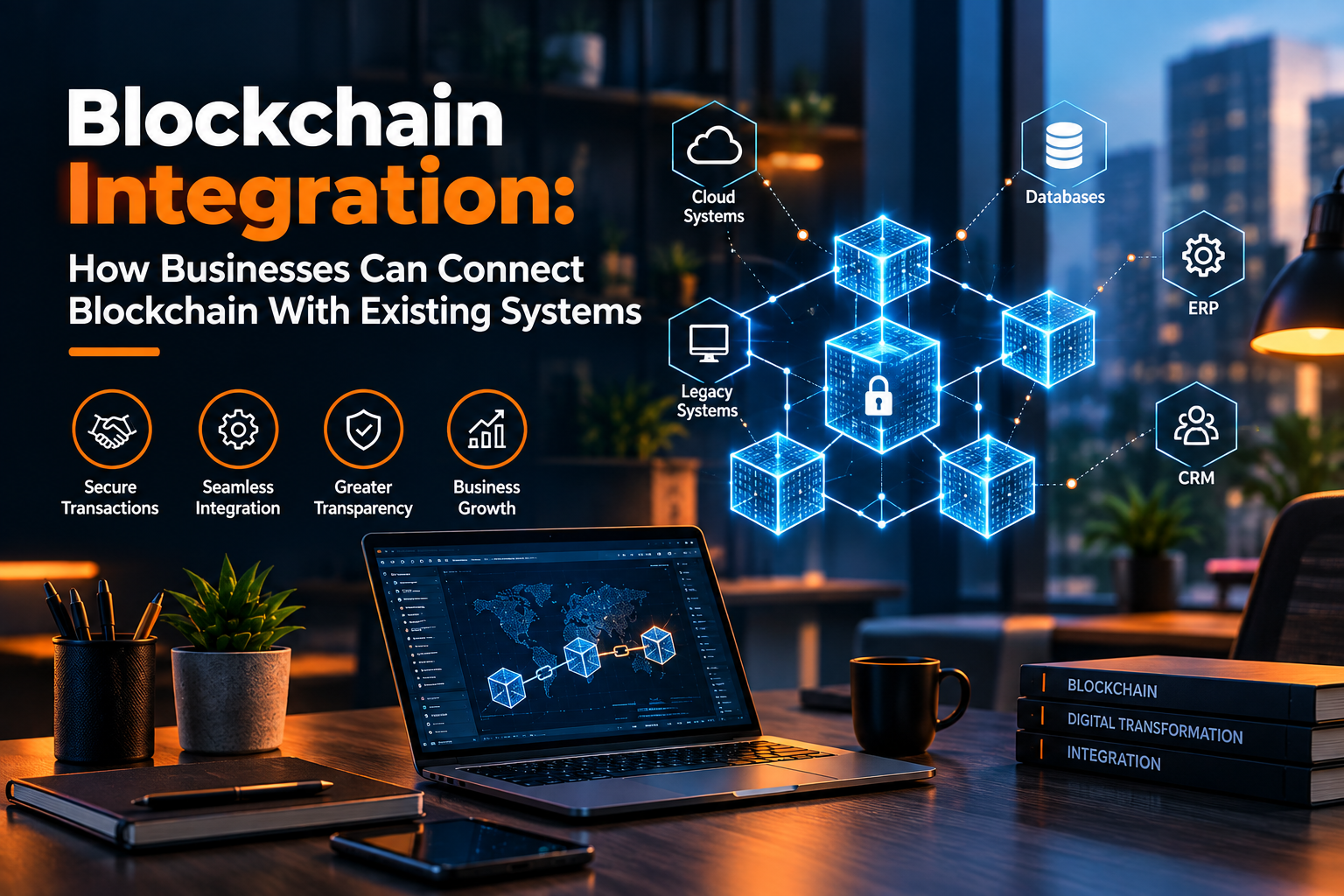
For many organizations, the practical approach is blockchain integration — connecting blockchain networks with existing ERP systems, CRM platforms, databases, payment systems, applications, and cloud infrastructure.
When implemented correctly, blockchain can work alongside existing technologies while adding new capabilities to business processes.
What Is Blockchain Integration?
Blockchain integration is the process of connecting a blockchain network or application with an organization's existing software, databases, APIs, and business systems.
Instead of operating blockchain as an isolated technology, integration allows businesses to exchange relevant information between blockchain-based applications and traditional systems.
For example, a company may connect blockchain with:
- ERP platforms
- CRM systems
- Supply chain management software
- Payment platforms
- E-commerce applications
- Cloud infrastructure
- Databases
- IoT devices
- Document management systems
- Business intelligence platforms
This approach allows organizations to benefit from blockchain while continuing to use their existing technology investments.
Why Businesses Are Exploring Blockchain Integration
Businesses generate and exchange large amounts of information across departments, partners, suppliers, customers, and service providers. Maintaining consistency and trust across these interactions can become difficult when information is distributed across multiple systems.
Blockchain can provide a shared and tamper-resistant record for selected business transactions.
Key benefits can include:
1. Improved Data Transparency
Blockchain can provide authorized participants with access to a shared record of transactions. This can improve visibility across processes where multiple parties need to verify the same information.
2. Better Data Integrity
Blockchain records are designed to be difficult to alter retrospectively. When combined with appropriate access controls and governance, this can help organizations maintain reliable transaction histories.
3. Enhanced Traceability
Businesses can use blockchain to track transactions, assets, products, or events across different stages of a process.
This can be particularly useful in supply chains, logistics, manufacturing, and asset management.
4. Automated Business Processes
Smart contracts can automate predefined actions when specific conditions are met. When connected with existing applications, this can reduce manual processing for suitable workflows.
5. Stronger Collaboration
Organizations often work with suppliers, distributors, financial institutions, and other external partners. Blockchain integration can create a shared transaction layer where appropriate, reducing the need for multiple parties to maintain separate versions of the same information.
How Blockchain Connects With Existing Business Systems
Successful integration usually requires more than simply deploying a blockchain network. Businesses need an architecture that allows blockchain and existing systems to communicate securely.
A typical integration can involve several layers.
Existing Business Applications
The process may begin with systems already used by the organization, such as ERP, CRM, e-commerce, or custom applications.
Integration Layer
APIs, middleware, integration platforms, or custom services can transfer relevant information between existing applications and blockchain networks.
Blockchain Network
The blockchain layer stores or verifies the information that requires distributed trust, traceability, or transaction validation.
Data and Database Layer
Traditional databases can continue storing operational information that does not need to be placed on a blockchain.
User and Reporting Layer
Business applications, dashboards, and reporting systems can present blockchain-related information to employees, customers, or authorized partners.
This architecture allows organizations to use blockchain selectively rather than forcing every business process onto a blockchain.
Common Blockchain Integration Use Cases
Blockchain integration can be applied across multiple industries and business processes.
Supply Chain Management
Businesses can connect blockchain with supply chain systems to improve product traceability and transaction visibility.
For example, information about product movement, ownership transfers, or verification events can be recorded and shared among authorized participants.
Financial Transactions
Blockchain can be integrated with financial applications to support specific transaction workflows, reconciliation processes, and digital asset operations.
Healthcare
Healthcare organizations can explore blockchain for selected data-sharing and verification workflows while keeping sensitive operational information within appropriate existing systems.
Manufacturing
Manufacturers can connect blockchain with ERP and supply chain platforms to create traceable records related to production, components, suppliers, and logistics.
E-Commerce
Blockchain integration can support areas such as transaction verification, product authenticity, loyalty systems, and digital ownership.
Document Verification
Organizations can use blockchain to record verification information for important documents without necessarily storing the complete document directly on the blockchain.
APIs: The Key to Connecting Blockchain With Existing Systems
APIs play an important role in blockchain integration.
An API can act as a communication layer between a traditional business application and blockchain infrastructure.
For example:
CRM → API → Blockchain Application → Blockchain Network
A business application can send selected information through an API, while the blockchain application processes the request and interacts with the network.
APIs can also allow blockchain-related transaction information to be retrieved and displayed inside existing dashboards or applications.
Blockchain Does Not Mean Putting Everything on the Blockchain
One common misconception is that businesses need to store all their information on a blockchain.
In practice, this is rarely necessary.
Blockchain can be used for information that benefits from characteristics such as:
- Shared verification
- Transaction traceability
- Tamper resistance
- Distributed validation
- Multi-party access
Other information can remain in traditional databases or cloud systems.
A hybrid architecture can therefore be more practical for many organizations.
Challenges of Blockchain Integration
Although blockchain integration can provide benefits, organizations need to consider several technical and operational challenges.
Legacy System Compatibility
Older applications may not have modern APIs or integration capabilities. Additional middleware or custom development may be required.
Data Privacy
Businesses need to carefully determine what information should be recorded on-chain and what should remain in private databases.
Scalability
Blockchain networks can have different performance characteristics from conventional databases. Integration architecture should therefore consider transaction volume and performance requirements.
Security
Blockchain itself does not eliminate security risks. APIs, wallets, smart contracts, authentication systems, and connected applications also require appropriate security controls.
Regulatory Requirements
Businesses operating in regulated industries need to consider applicable data protection, financial, contractual, and industry-specific requirements.
Integration Complexity
Connecting multiple systems can become complex when businesses have several legacy applications, cloud services, databases, and third-party platforms.
Best Practices for Blockchain Integration
A structured implementation approach can help reduce unnecessary complexity.
1. Identify the Business Problem First
Blockchain should solve a clearly defined business or operational problem. Technology adoption should not begin simply because blockchain is trending.
2. Select the Right Blockchain Architecture
Organizations should evaluate factors such as permission requirements, transaction volume, participants, data sensitivity, and integration requirements before selecting a blockchain platform.
3. Use APIs and Middleware
A well-designed integration layer can help separate blockchain functionality from core business applications and make future changes easier to manage.
4. Keep Sensitive Data Off-Chain When Appropriate
Sensitive or large datasets may be better stored in secure traditional systems, with blockchain maintaining relevant verification or transaction references.
5. Implement Strong Access Controls
Authentication, authorization, encryption, key management, monitoring, and auditing should be considered throughout the integration architecture.
6. Start With a Focused Use Case
A pilot project can help organizations validate technical feasibility, business value, performance, and integration requirements before expanding blockchain across multiple processes.
The Future of Blockchain Integration
Blockchain is increasingly being considered as part of broader digital transformation strategies rather than as an isolated technology.
As businesses continue adopting cloud platforms, AI, IoT, automation, and enterprise applications, integration will become increasingly important.
The future of blockchain adoption is likely to involve hybrid architectures where blockchain works alongside existing databases, APIs, cloud services, ERP systems, CRM platforms, and business applications.
The objective is not necessarily to replace existing technology, but to connect the right technologies to create more transparent, secure, and efficient business processes.
Conclusion
Blockchain integration allows businesses to connect blockchain capabilities with the systems they already use. Through APIs, middleware, smart contracts, and hybrid architectures, organizations can introduce blockchain into selected workflows without completely replacing their existing infrastructure.
From supply chain visibility and transaction verification to document authentication and business automation, blockchain can support a range of enterprise use cases when implemented with a clear business objective and appropriate architecture.
Businesses planning blockchain adoption should evaluate their existing systems, integration requirements, security needs, scalability, and regulatory considerations before selecting an implementation approach.
For organizations looking to explore blockchain integration, CLOPID provides technology solutions designed to support modern business infrastructure and digital transformation.
Explore CLOPID's Blockchain Solutions to learn more about how blockchain technology can be incorporated into modern business systems.
Frequently Asked Questions
1. What is blockchain integration?
Blockchain integration is the process of connecting blockchain technology with existing business applications, databases, APIs, and enterprise systems.
2. Can blockchain work with existing ERP and CRM systems?
Yes. Blockchain can be connected with ERP and CRM systems through APIs, middleware, custom applications, and integration platforms.
3. Does all business data need to be stored on blockchain?
No. Businesses can use hybrid architectures where blockchain stores or verifies selected transaction information while operational data remains in conventional databases.
4. What are the main benefits of blockchain integration?
Potential benefits include improved traceability, data integrity, transaction transparency, automation, and multi-party verification.
5. Is blockchain integration suitable for small businesses?
It depends on the business problem, transaction requirements, technology infrastructure, and expected benefits. A focused pilot can help determine whether blockchain is appropriate.